







Failing Forward: Why Mistakes Are Your Greatest Assets
Failure is a vast subject; however, I will condense our exploration into a manageable number of aspects for the sake of simplicity. We'll look at the Failure Response Modality Continuum, a model that categorizes different responses to failure, from avoidance to acceptance and learning. We'll also explore inventors who embraced testing failures, the psychology of failure, and the benefits of ‘failing forward.’

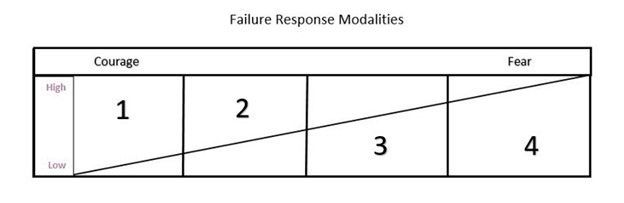
Having been involved in the process observation of groups and individuals within groups for over almost five decades, I will address the four distinct individuals in my audience. In viewing a continuum of emotional responses to perceived failures, I identify four responses to failure.

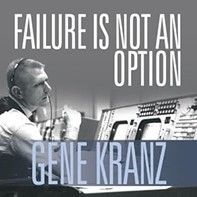
Gene Kranz, NASA Flight Controller
The first quadrant person is courageous, as exemplified by Gene Kranz, an early NASA flight controller, who on February 24, 1997, exhibited calm and poise as he problem-solved how to extinguish a fire that had ignited in the oxygen-generating system with the crew of the Mir space station. The flames lasted several minutes, cutting access to one of the two Soyuz escape vehicles, and filling the station's modules with smoke. With a team attitude of "Failure is not an option," his team resolved a problem that could have been disastrous if emotions had taken over rather than reason.

The second quadrant person is brave but cautious. She takes reasonable risks. She confronts failure as an opportunity to learn, grow, and go again. 2's and 3's can approach the middle of the continuum, where there are equal measures of courage and fear, which might feel like an anxious, conflicted place to be. Courage pushes you to act, whilst fear says, "apply brakes gently as we go around this blind bend. Watch out."

Abraham Lincoln
When I think of someone typical of quadrant 2, Abraham Lincoln comes to mind. He had a good measure of both reasonable fear and courage in trying to keep the union together. His career is a perfect example of 'failing forward.' Note Lincoln's notable personal and political failures:
- 1831: Failed in business. His general store went bankrupt, and he spent years paying off the debt.
- 1832: Lost his first election for the Illinois State Legislature.
- 1833: Failed in another business venture.
- 1835: His sweetheart, Ann Rutledge, died, causing him to suffer a nervous breakdown.
- 1838: Was defeated for Speaker of the Illinois House.
- 1843: Was defeated for the nomination for Congress.
- 1848: Lost his bid for renomination to Congress.
- 1849: Was rejected for a land officer position.
- 1854: Was defeated in his run for the U.S. Senate.
- 1856: Was defeated for the nomination for Vice President.
- 1858: Was defeated again in his run for the U.S. Senate.
- 1860: Elected POTUS

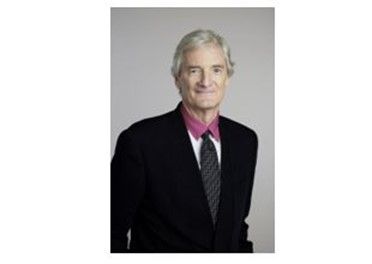
Sir James Dyson: "Inexperience is an advantage."
A quadrant three person is more often motivated by fear instead of courage. As war prisoners, they may have more fear than enough courage to confront their captors, and thus confound their captors with disinformation. I imagine Sir James Dyson as a quadrant three person because he had to endure others trying to rip off his brilliant ideas.
Naturally, he feared losing control of his patented concepts to competitive inventors, especially after having experienced 5,126 failed prototypes and taking 15 years to perfect the bagless vacuum cleaner that would eventually make him a billionaire. Curiously, every single investor he approached with the cyclonic circulation vacuum cleaner concept rejected him. They thought it would threaten the paper bag business.
In 2017, Dyson invested £7 million a week in the research and development of new products for his company, which is now the UK's largest investor in robotics and artificial intelligence research. The company employs over 3,500 engineers and scientists and engages in more than 40 university research programs. Sir James Dyson's tolerance for mistakes was admirable. He hired young, inexperienced workers because they were easier to train, and because they would bring fresh thinking, new ideas, and errors during their learning curve that would help them improve. He said, "Failure is not catastrophe." He embraced failure as a stepping stone.

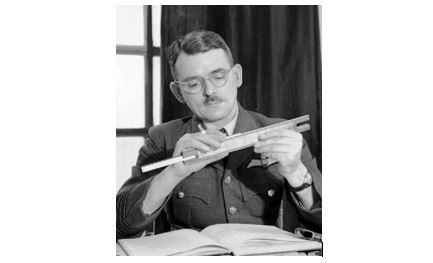
Frank Whittle
A quadrant four person might be Frank Whittle, who had to anticipate successive failures for each of his progressively more advanced scientific experiments. He invented the jet engine, a radical departure from piston-driven engines that rotated aircraft propellers. Expecting testing failures for each of the design’s specifications, such as component temperatures and pressures, he patiently experienced fear at each stage of experimentation. At any point a prototype engine might self-destruct, given the first experiment's dismal failure, a huge explosion.
Frank Whittle realized that for the UK to win World War II, it would need a plane that did not have the limitations of a propeller-driven airplane. As a synergizer, he envisioned an aircraft that could fly higher and faster than any current model, and then began rethinking the airplane engine. Piston-driven combustion engines and propellers would not operate in thin air at high altitudes. Whittle imagined aircraft flying at 500 mph and altitudes of 40,000 feet, in much thinner air. A propeller of the size and weight needed to absorb the power of a gas turbine at these extreme speeds and altitudes would be impractical and inefficient. He deduced that the most efficient way to fly at high altitude was with a jet of hot exhaust gases for thrust.
Whittle thought the internal combustion engine had too many parts. Instead, he envisioned only one part, a rotary shaft, driven by a totally new design. Several renditions of his concept had to be developed to achieve the final ideal operational temperatures and optimal pressures for maximum speed. A stream of prototypes failed until all the specifications were adjusted for the best performance.

Actually, Hans von Ohain of Germany was the designer of the first operational jet engine. However, credit for the invention of the jet engine is often attributed to Frank Whittle of Great Britain. Whittle, who registered a patent for the turbojet engine in 1930, received that recognition but did not perform a flight test until 1941. Curiously, they were science friends.
Thanks to all the multiplicative testing failures, jet technology eventually enabled the Airbus A380 to cross the Atlantic in just seven hours. Even faster, the NASA X-43 is the fastest aircraft in the world. This experimental unmanned scramjet vehicle achieved a top speed of Mach 9.6 (about 7,366 mph or 11,854 km/h) in 2004. If only those two bicycle mechanics famous for their Kitty Hawk, North Carolina experiments could now see how far aviation has come.

Pygmalion and Galatea by Auguste Rodin
Psychology of Failure and the Pygmalion Effect
The Pygmalion Effect is the power of expectations. According to Greek myth, Pygmalion was a legendary sculptor in Cyprus who, dissatisfied by physically imperfect women, created a statue of his ideal woman. He fell in love with the statue and treated his beauty as a confidante, bringing gifts, dressing it, and even caressing and kissing it, according to the Centre of Excellence. He wanted a woman exactly like his perfectly sculpted girl. The goddess Venus fulfilled his dream expectations and granted his wish, transforming his statue into a living woman named Galatea. Pygmalion married Galatea.
In 1912 George Bernard Shaw wrote a play called Pygmalion in which two gentlemen bet on whether a teacher's attention and expectations can affect the outcomes of a student's learning. The story centers on Henry Higgins, a brilliant but arrogant phonetician, who makes a bet with his fellow linguist, Colonel Pickering. Higgins boasts that he can transform a poor, uneducated Cockney flower girl, Eliza Doolittle, into a refined lady who can pass for a duchess simply by teaching her to speak and act appropriately. This play was transformed into a 1964 Hollywood musical starring Audrey Hepburn and Rex Harrison, titled "My Fair Lady."
Numerous research studies cite examples of experiments in which teachers were informed that some of the students in their classroom would be bright and others slower. These identified subsets of students in the classroom performed exactly as the teacher was led to believe they should, despite all the students being at the same academic level, based on how much attention she gave to the differently labeled groups. The point is that generally, people tend to live up to the expectations of others. This is why it's so important to have a mentor, coach, or friend who believes in you when your confidence wanes, and why it’s important to positively expect better when adolescents misbehave. Negative thinkers tend to live down to their expectations.
Faye Hu Shines a Light of Hope
I know an acquaintance who is a paranoid conspiracy theorist whose faith in the basic goodness of life itself is weak. Joy and mirth are tragically absent from their daily life. Instead, they live bound to their negative expectations, and thus suffer 'quiet days of desperation.' They surrender to an attitude of learned helplessness and fatalism, the coward's way out, says Faye Hu. Do you know anyone with this mindset?

"A plurality of Americans believe that life was better 50 years ago. A recent international study revealed that only 10% thought the world was getting better." - Faye Hu
Fatalism as a Pygmalion Motivator for Failure
Columbia University student Faye Hu makes a good point that complaining about things and mentally arguing with the perceived enemy is non-productive, although bitching is a commonly accepted gossip habit. In a time when real existential threats linger like a sword of Damocles above our collective heads, doing nothing is not an option, she asserts. We face simultaneous crises with climate’s increasingly larger, more impactful environmental changes, drugs destroying lives, global trade in freefall, and democracies falling to dictatorial despots. Faye Hu's ideas are simple. With a virtually impossible to alleviate debt list, the USA now faces a credit crisis, needing to pay off massive debt that has provided Americans with the good life for so long. Now it's time to pay the piper.
The world is in a state of economic insecurity. Territorial wars and the threat of wars saturate our attention and distract us from their origins. The Gaza conflict has deep historical roots in which both parties are victims. It is an example of the concept that 'whenever a fight has continued for too long, it is a sign that both parties are at fault.' To understand the objective reality regarding Israel and Palestine, read Daniel Sokatch's book, Can We Talk about Israel? A Guide for the Curious, Confused, and Conflicted. It offers a clear and balanced overview of the Israeli-Palestinian conflict and it may give you hope for peace. "Fatalism is the coward's way out," reminds Faye Hu, who encourages us to maintain hope.

John C. Maxwell
John Maxwell and Failing Forward
John C. Maxwell, renowned leadership speaker and author of Failing Forward, elucidates his understanding of failure as a valuable learning and growth experience with easily digestible, simple concepts. His main point is this: "The major difference between winners and losers is their perception of and response to failure."
Maxwell reminds us that failure is not final and that success is not a destination but a process, just like failure. Using a scientific learning process, Maxwell’s success cycle involves five steps. First, you test assumptions. All good leaders test assumptions. Secondly, you fail. Thirdly, you learn from mistakes. Fourthly, you make adjustments for new improvements. Fifthly, you re-enter or reengage.
Maxwell loves acronyms and provides this one for dealing with failure and success: "R.E.A.L." The R stands for relationships because success or failure almost always involves others.
The E stands for equipping, a classic Maxwell tactic, equipping others. This means providing others with what they need to succeed. For example, whenever I visit the local diner, I make a point of introducing myself and remembering my server's name. Consequently, they are equipped with my name, and whenever I arrive, they greet me and provide excellent service.
The third letter A stands for attitude. Of course, attitudes are motivators of behavior. So, if you want to change your results, change your attitude and behavior, and outcomes will follow. How to actually change attitudes is another discussion for another time. Lastly, the L stands for leadership. Personal effectiveness is about how we lead our lives, so, in that respect, all persons ought to develop their leadership skills; otherwise, they will follow behind someone who did.
Ponder Maxwell Maxims:
- Failure is not final.
- Achievers reject rejection.
- Failure does not equal catastrophe.
- Failure is not a character statement.
- You've failed, but you're not a failure.
- There are no mistakes, only lessons to be learned.
- Failure is not a single event. It is a process, like success.
- Train for failure. The bottom could fall out. How will you fail forward?
- The ability to see failure positively is an acquired attitude. Don't fear failure.
- Failure is not the opposite of success. Failure and success are friends.
- Failure is necessary for success.
- Failure is the price we pay to achieve success.

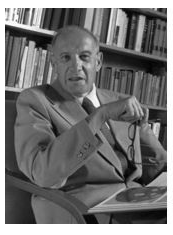
Peter Drucker
Peter Drucker's Take on Failure
In his seminal work, Innovation and Entrepreneurship, Peter Drucker identifies sources of innovative opportunity, the first being unexpected successes and failures. His core concept: “Systemic innovation requires failures.” Consider the United States’ space program failures.
Key Points on Failure and Systemic Innovation
· Failure as a Symptom of Change: Like me, Drucker valued a well-planned, well-executed failure more than a success because of the educational opportunity afforded by learning from mistakes. He suggested a constructive attitude when facing failure is, "What can we learn from this?"
· The Importance of Analysis: Failures, according to Drucker, offer undiscovered opportunities for fresh perspectives. Self-analysis is second nature to professional salespersons.
· ‘Fast-Failing:’ Hurry up and get all the necessary iteration mistakes out of the way. Drucker encouraged ‘fast-failing,’ especially at the start of a project, making many micro-mistakes and adjustments. Such timely data is then called feedback. His big question about failures was, "Why did this fail despite being carefully planned and executed?"
In summary, Peter Drucker saw failure not as an end but as a crucial starting point for inquiry and innovation. For him, a disciplined approach to analyzing and learning from failure is a core component of any organization's strategy for systemic and purposeful innovation.

The Benefits of Failures: A Catalyst for Growth
So, what have my failures taught me? My failures taught me that I have nothing to lose by experiencing them, for they are a most valuable teacher. My most tragic experiences, in the end, have produced a more resilient person who values emotional intelligence and self-awareness. My failures have mainly taught me humility, a significant lesson for an ego that has been unavoidably inflated over the years by recognition ceremonies, online accolades, and various awards, and trophies. Having been blessed with personal failures and having changed at depth because of them, my persona is hardly recognizable from who I was years ago, or even last year.
Another advantage of failing is that I've learned to roll with the punches, the second thing my father taught me as a boxer. The first thing he taught me was to learn how to fall without hurting myself, falling forward.
My most significant lesson has been not to fear experimentation and the testing of assumptions. I've learned to not be bound by my comfort zone, and to adopt new attitudes, and behave in new, more productive ways. Using a post-mortem analysis process to analyze my failures has done three important things: 1) removed my fear of failure; 2) encouraged an atmosphere of experimentation and innovation; 3) improved my relationships, even those once distant.
To me, the greatest failure is being unteachable by failure, and doomed to repeat failure attitudes and patterns. How has failure benefitted you? Think.
-Frank DeDominicis
REFERENCES:
James Dyson Net Worth 2025 Forbes Richest in UK Glusea.com.
https://www.glusea.com/james-dyson-net-worth/
Pygmalion Effect
https://en.wikipedia.org/wiki/Pygmalion_effect
Pygmalion Effect example:
https://www.supersummary.com/pygmalion/book-brief/
Pygmalion in Greek Mythology
https://www.centreofexcellence.com/pygmalion-greek-mythology/
Give me 8 minutes and I'll DELETE your fear of failure
https://www.youtube.com/watch?v=Cw5bEL9rxXw
Failure Is Not an Option: Mission Control from Mercury to Apollo 13 and Beyond
https://www.amazon.com/Failure-Not-Option-Mission-Control/dp/1439148813 https://www.youtube.com/watch?v=2uY8-7E05rE
The Tara Westover Story – How an uneducated redneck kid discovered the real world https://www.youtube.com/watch?v=q9S7tdz80wo
Tara Westover, author of Educated
https://www.youtube.com/watch?v=2d9I18Wdsuc
Author Tara Westover’s Incredible Story About Leaving Her Strict Survivalist Family
https://www.youtube.com/watch?v=is635n6RNR0
Dyson Founder Breaks Down His Biggest Inventions and His 'Life of Failure' | WSJ
https://www.youtube.com/watch?v=R21A84A-NLk&t=1s
Dyson: The Future of Farming
https://www.youtube.com/watch?v=FA6BCIWPJ30
Are We Doomed? How Fatalism Presupposes Failure | Faye Hu | TEDxYouth@WAB
https://www.youtube.com/watch?v=pjYP2Wj0Wqc
Genius of the Jet | The Invention of the Jet Engine: Frank Whittle | PART 1
https://www.youtube.com/watch?v=crRbwtWquvw&t=1s
25 Years Ago: Fire Aboard Space Station Mir
https://www.nasa.gov/history/25-years-ago-fire-aboard-space-station-mir/
Are We Doomed? How Fatalism Presupposes Failure | Faye Hu | TEDxYouth@WAB
Recent Posts