






The Interconnectedness of Love, Empathy, and Social Media

July 6, 2026

Share this article

December 25th commemorates the birth of the most influential, controversial life, that of Jesus Christ, whose teachings centered on the phrase "Love one another." This universal ideal is a vision of a utopian society resonating with peace and harmony.


However, despite this lovely aspiration, we confront a sobering reality of a world of persistent "wars and rumors of wars," casting doubts for many about the possibility of society ever attaining an enduring peace and power equilibrium worldwide. Often, particularly from young people, I hear discouragement and negative expectations about the future.


The contemporary state of our global affairs is a disheartening landscape. Societal discord, aggravated by wealth inequality, ethnocentric prejudices, mismanagement of natural resources, and ingrained biases, paints a bleak picture of our collective future. Today's youth grow up in a world where negativity, although not representative of the larger reality, dominates daily news noise, including distressing reports of an average of two mass shootings per day.

The mass migration from personal tete-a-tete conversations in actual rooms to virtual communications has accelerated narcissism. Our self-interest drives us to draw the attention of Facebook contacts by posting pictures from our personal lives, environs, and even our meals.


Instead of dwelling solely on negative trends, let’s probe deeper into the underlying societal shifts and their root causes. Toward the end of this article, we'll explore the multifaceted nature of love as defined by the ancient Greeks. Even in conflict, such as war, an underlying motivation emerges, love for one's country, a form of self-love. Numerous surveys conducted in the United States indicate a decline in empathy over the past four decades, with the recent acceleration attributed to factors like the prolonged lockdown, increased social media dependence, and online addiction.

Compassion connects hearts
The Empathy Crisis

An eye-opening meta-analysis spanning several decades revealed a staggering 40% drop in empathy among American college students. Scholars primarily attribute this decline to the pervasive rise of social media. Moreover, the COVID-19 pandemic further exacerbated this trend, particularly affecting millennials, among whom empathy ratings decreased by nearly 20%. Women experienced a more pronounced decline, with their empathy ratings dropping by 19%, compared to an 8% decrease among men.


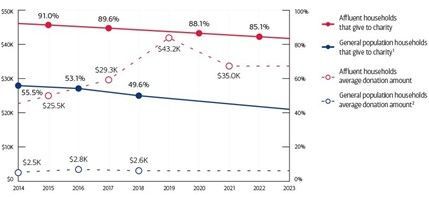
In 2020, a Scientific American article highlighted America's empathy deficit, pinpointing its adverse impact on various medical, economic, political, and societal spheres. Reduced social interaction due to the pandemic, reliance on online communication, and masked conversations have inadvertently stifled opportunities for genuine empathy. Amid personal struggles, many individuals find themselves less attuned to the problems of others, further exacerbated by the indifference displayed by some leaders more interested in reputational infighting than legislative work. Fellow citizens, for the most part, have gotten more indifferent to the needs of others. Some citizens showed their indifference to others by resisting social distancing and masking. This indifference affects philanthropy. Ask anyone working in cause-based non-profit fund-raising about the anticipated 2024 gifting trends.

Charitable Giving Trends

The empirical evidence is clear. Empathy levels are on a downward trajectory in the U.S., especially among millennials, with women bearing a disproportionate impact. Social media's rise and decreased face-to-face interaction during the pandemic are pivotal factors driving this decline.

God is Love

The phrase "God is love" evokes contemplation. If God is that which is ultimately indefinable and completely indiscernible, it reasons that love is only partially understood based on our experience. We must examine love through the lens of our observations and limited human understanding, and not only in terms of romantic expression. Inherent in our nature, love propels our desire to connect with others at various levels and frequencies.


My most profound lesson regarding our loving human nature was on March 11th, 1976 during the U.S. bicentennial year, which coincided with the birth of my twins, Jesse James and Billy DeDominicis. Their premature birth, each weighing merely four pounds and six ounces, and how they first met each other revealed to me an astonishing aspect of human connection.

Jesse James & Billy the kid

As they lay side by side in a shared incubator, their tiny frames were small enough for me to cradle each in a hand. I witnessed an incredible display of affection. They tried to roll toward each other, reaching for each other. I saw them shortly after their vital signs stabilized, in a common incubator, trying to roll over to hug each other. My eyes leaked with joy. What a precious father moment and a lesson about the inborn, spontaneously loving side of human nature!


My poignant peak experience underscores the desire for connection present in infants. Studies indicate that babies weep in response to other infants' cries, a form of empathetic response. Bright lights, despite gauze eye coverings, and noise made my infants cry, but they consoled one another. This is one of my favorite memory videos to replay in my head, to feel that deep, deep love again.

Empathy Research Findings

Social Psychologist Dr. Sara Konrath presented her research findings to the American Psychological Association yield critical insights into empathy. Her findings highlight various facets of empathy:


Diverse individuals exhibit varying levels of empathy. Some possess cognitive empathy, an intellectual understanding of another's situation, while lacking emotional empathy. They are apathetic and just don't care. It's not meanness, just a preferential style.


Empathy enriches interpersonal relationships and contributes to better health outcomes. Prosocial behavior elevates oxytocin levels and lowers cortisol levels, correlating with lower mortality rates. Givers physically benefit from having a positive self-image because a mental view of oneself affects oxytocin and cortisol levels. Empathy motivates non-profit giving. Philanthropy often stems from genuine care rather than solely seeking tax deductions.


Empathy is a learnable trait yet remains elusive for individuals with narcissistic, sociopathic, or psychopathic tendencies. Studies among incarcerated individuals reflect lower levels of cognitive and emotional empathy.

Cultural engagement through arts like reading fiction or emotionally moving music cultivates empathy, which has the potential to nurture a compassionate inclination between individuals.


Deep-seated empathy often matures into compassion, evident among volunteers and givers. Volunteers who give of their time, not necessarily money, with positive self-perceptions, exhibit elevated oxytocin levels and reduced cortisol.

Geographical factors influence emotional warmth. Warmer climates often correlate with warmer personalities, so relationships have less emotional distance.


While social media attracts attention-seekers who want to draw the attention of many others, a positive correlation exists among those who are instead motivated by leaving a legacy. These individuals harness social media to address communal issues, fostering goodwill and support within online communities.


Dr. Konrath's innovative Text to Connect© program employs daily text reminders that encourage caring behaviors. Implementing Interpersonal Activity Index™ tests among college-level and younger students, her program significantly increased participants' prosocial motivations and behaviors, exerting enduring effects for up to six months.

The U-bend of Life
The U-bend of Life

Prof. John Gladman claims that happiness seems to increase starting at age 53, and then slowly climb up, a big jump up from age 61-69. This is called the ‘U-bend of Life.’ The 30s and 40s are tough times in life.


Empathy may have a medicinal quality in mitigating alienation. However, the reality persists that some individuals are entrenched in the midlife ‘U-Bend,’ balancing responsibilities between caring for children and elders while maintaining work and familial commitments. This ‘sandwich generation’ finds itself ensnared in a vortex of urgencies. Because of the need to manage multiple demands, focusing on things beyond immediate priorities becomes difficult.


Those entrenched in the U-bend trough stage of life grapple with the constant pressures of achievement. Middle-aged individuals find themselves unavoidably preoccupied with self-survival and self-interest pursuits. The U-bend theory posits that our early years often seem comparatively simple, whereas middle age means a constant quest for status, financial stability, power, and expanding one's options. Survival instincts and the pursuit of achievements leave little emotional bandwidth or time for others.

Eros stringing his bow
Greek Flavors of Love

Love, a profound and mysterious sentiment, transcends mere romantic emotions. The ancient Greeks identified several types of love:


Eros

The Greek god of fertility symbolizes lust and sexual passion. Shakespeare, in Othello, portrayed the sexual intimacy of a couple as a "beast with two backs." Eros encompasses life-preserving instincts and impulses to satisfy primal needs to preserve the body and mind.


Philia

Deep friendship. People often forge strong bonds through mutual suffering or shared adversity. I recall the courageous alliance formed between two young prisoners, the first to escape the Auschwitz-Birkenau 'work' camp before it had fencing and walls. Alfred Wetzler & Rudolf Vrba escaped and were the first to expose Nazi atrocities in a paper about life in the camp and the extermination process. They exemplify this deep philia bond.


Ludus

Playful Love - The best example of ludus love is in the typical flirtatious exchanges intoxicated men and women enjoy after a bit of alcohol relaxes inhibitions at the local watering hole. Such communication flatters with obvious intent, showing appreciation for the other person and their attributes, joking, playfully teasing, and assuming a sense of closeness. Fair warning: Dr. David McClelland reported that one drink of alcohol lubricates social connections by reducing inhibition levels and lessening friction. However, excessive alcohol consumption can make a person more self-interested and self-conscious, contributing to interpersonal tension and emotional distance.


Storge

Familiarity and fondness characterize this love, stemming from intimate knowledge of and essential interactions with another person. "Storge ["store-jay"], or familial love, is a kind of philia pertaining to the love between parents and their children. It differs from most philia in that it tends to be unilateral or asymmetrical, especially with younger children. More broadly, storge is the fondness born out of familiarity or dependency. Compared to eros and philia, it is much less contingent on our personal qualities." - These Are the 7 Types of Love | Psychology Today


Agape:

Universal love - This is the love of life, of all creation, and all experiences. It is the feeling of love described by those who feel they are in touch with the source of joy in living. They appreciate all life experiences as sources of insight and growth. "Agape, in the New Testament is the fatherly love of God for humans, as well as the human reciprocal love for God. In Scripture, the transcendent agape love is the highest form of love and is contrasted with eros, or erotic love, and philia, or brotherly love."                  - Agape | Definition, Scripture, & Uses | Britannica


In a religious sense, agape love represents God's fatherly love for humans and humans' reciprocal love of God. In a secular sense, it means to love others unconditionally.


Pragma

Longstanding love - On March 7th, 1965, Elwin Williams, an Alabama Klansman, viscously beat John Lewis. Years later, he met John as a Congressman in Washington, D.C., and befriended him. He asked for forgiveness, fearing God would condemn him to hell for his brutal Ku Klux Klan activities. The two became fast friends, speaking on the power of real forgiveness on talk shows like Oprah's. They remained close friends until John died in 2020. Shared forgiveness often marks the foundation of this kind of love.


Philautia

Self-love - The Greeks recognized two types of Philautia: a positive one, with high esteem and self-compassion, and a negative one, which is narcissistic, arrogant, and selfish.

Expectations are Self-fulfilling
Self-love Challenges

Poor Self-image / Low Self-esteem                                                                                                   

Negative Self-Talk                                                                                                                         

Comparing Oneself to Others                                                                                                   

Perfectionism                                                                                                                                                     

Past Experiences                                                                                                                                     

External Validation                                                                                                                                     

Self-Care Neglect                                                                                                                                             

Fear of Vulnerability                                                                                                                                     

Lack of Boundaries                                                                                                                             

Difficulty Forgiving Oneself


My revelation about the subject of a higher love came after seeing a video of Rhoda Wise of Canton, Ohio who was allegedly visited in 1930 by Jesus Christ. It made me think about the mystery X factor, that anything can happen anytime, anywhere, to anybody. Miracles happen.


Considering that fact, and while I love friendship and love, like everyone else, for a long while I've been out of touch with old friends and now find that some are no longer with us, have suffered losses, or have changed not for the better. Having only recently learned of several old friends afflicted with strokes and cancer, more than ever, I realize a new appreciation of the sanctity of life. In my heart of hearts, I feel the fire of my empathy for all others. Now, especially during this season of family and love, my motivation is to reach out and touch the hearts of others, especially those who need love the most.


-Frank DeDominicis

REFERENCES
REFERENCES

Recent Posts

July 7, 2026
This article in this series will be concise for two reasons: 1) It's a nasty subject that is already amply covered by many other researchers and writers; 2) My preference is to move beyond statistical reports and societal trends to defining root causes of violence, and to suggest some proactive strategies for mitigating workplace violence. As case studies abound, instead, I will share observations about the core reasons for workplace violence and some ideas for how to prepare for and prevent violence. AI suggested providing statistics and case studies, which will be listed below in the reference area. I do not want to flood your mind here with evidence of man's inhumanity to man. You already know that mass shootings have transitioned decades ago from a rare occurrence to hundreds every year, so I won't bore you with bloody references. Overall, during the past few years, there has been a downward trend in violence in our cities' streets. To me, the real tragedy is that we have been conditioned to accept violence as commonplace and usual, when we should be outraged at the continual loss of lives and sanity. Alas, many seem too mesmerized by the latest bad news event to stop and focus on preventive measures. Enlightened leaders install workplace violence policies and protocols.
July 6, 2026
Given the popularity and propensity of quick-fix recipes, systems, solution processes, or courses, including everything from the Tyranny of Noisehow to cut a mango to how to live the perfect life, I've decided to venture where cynics go to share ideas on how to screw up everything in your personal and business life. This is intended as tongue-in-cheek discourse and a public confession (albeit craftily embedded within) about my bad and sometimes embarrassingly inappropriate decisions. 'Negative assertion,' a concept taught in the 80s in Assertiveness 101, always delights.
July 6, 2026
The January 2026 Minneapolis tragedies—especially the ICE murders of Renée Nicole Good and ICU nurse Alex Jeffrey Pretti—have evolved from ‘breaking news’ to what psychologists term a ‘cascade of collective traumas.’ The relentless flow of disturbing reports significantly impacts people, both positively and negatively, creating fertile ground for those who profit from chaos and confusion. The Minnesota failures of our safety system are ‘critical error’ messages in our social contract. ICE criminal abuse events, captured on high-resolution video and distributed via 24/7 news cycles, are a profound psychological ‘distraction engine’ that directly impacts the modern workforce, everybody from the custodial engineer down to the lowly and humble CEO.
July 6, 2026
Like you, I am always trying to make sense of things, especially the deepest, most perplexing, confusing, or foreign things. As a much younger man, one of the most foreign things I’ve never really completely understood was how global trade magically and smoothly emeshes the distribution of natural resources and manufactured components for goods for the 166 World Trade Organization members. Recently, I’ve re-learned that global trade is anything but smooth and simple. In fact, the experts taught me how to properly perceive the reality of the current world trade situation and its inevitable trajectory towards increasing chaos and uncertainty. So, here’s a curious outsider’s insights into a complex and politicized arena: international trade.
By Frank DeDominicis May 26, 2026
Employee Healthcare can cost half as much. Just imagine a world without co-pays and high deductibles. “In the world of employee benefits, a seismic shift is underway, and it's causing tremors of concern for some of America's biggest companies,” says Jed Cohen, cofounder of Fiduciary In A Box . He reports“ Attorneys filed a first-of-its-kind against Johnson & Johnson for its employee health benefits plan.” Recently I learned from Bob Hilke, an expert in Wellness and Healthcare, about a positive and hopefully healing tsunami of change rolling over our broken health care system. Given the perennial corporate problem of employee retention, finite dollars available for costly employee health insurance benefits programs, and inertia inherent within the current purchasing practices, I am impressed by the efficiency and effectiveness of the Nuka health system. Unlocking the Benefits of the Nuka Healthcare System The Nuka System , pioneered by the Alaska Native Medical Center, revolutionizes healthcare with its patient-centric approach. Emphasizing preventive care, continuity of care, and cultural competence improves health outcomes while respecting community traditions. Medical experts from around the world come to Alaska to study the system. While Nuka is the only healthcare system to receive the Malcolm Baldrige award TWICE and many countries from all over the world come to Alaska to see the Nuka Healthcare System, Alaska rarely receives visits from any of the other USA forty-nine states to see the Nuka system. Preventive care is prioritized, reducing the need for costly interventions. Integrated care teams provide personalized treatment plans, enhancing patient satisfaction and outcomes. Cultural sensitivity fosters trust and effectiveness in healthcare delivery. Recent news highlights ERISA violations by significant corporations, underscoring the need for ethical healthcare practices. As advocates for patient welfare, we must prioritize systems like Nuka that prioritize patients over profits.
By Frank DeDominicis November 19, 2025
The American business landscape is silently bleeding. For decades, a hidden, metastasizing cost has consumed profits, eroded competitive advantage, and driven employee anxiety: the national healthcare crisis. Often cited as the second-highest expense on a company’s balance sheet, healthcare spending today represents a systemic failure, offering diminishing returns for escalating premiums. It is a cost that CEOs have learned to dread, manage, but never truly solve.