















Broken Bonds: The Anatomy of Failures in Professional and Personal Spheres

July 6, 2026

Share this article

Given the popularity and propensity of quick-fix recipes, systems, solution processes, or courses, including everything from the Tyranny of Noisehow to cut a mango to how to live the perfect life, I've decided to venture where cynics go to share ideas on how to screw up everything in your personal and business life. This is intended as tongue-in-cheek discourse and a public confession (albeit craftily embedded within) about my bad and sometimes embarrassingly inappropriate decisions. 'Negative assertion,' a concept taught in the 80s in Assertiveness 101, always delights.

“It’s not supposed to be easy. Anyone who finds it easy is stupid.”

-Charlie Munger, Vice-Chairman of Berkshires/Hathaway 

Let's begin an idea from Keith J. Cunningham's book The Road Less Stupid and discuss how to mess things up in a grand way. He reminds us that we have all paid a 'dumb tax' and lost financially because of erroneous assumptions. A problem is that often, we don't ask ourselves, "What erroneous decisions might I be making now?" Have I been less impulsive in some of my early business decisions, a victim of self-sabotage? As Cunningham suggests, "All my problems started out as a good idea that was emotionally justifiable at the time." Pause and reflect on this for a moment…or pay the dumb tax by default.

With self-sabotage in mind, let's begin our journey into ignorance. Oh, where to start? Let's start with you, the one who may have been or is a problem for others. Are you ready for an honest discussion with the person in the mirror or to receive blunt, direct feedback from a caring friend?

"Studies show that evaluation recipients must be receptive and accurately understand the meaning and veracity of the feedback (i.e., discern the truth in feedback). Honesty is critically important for both receptivity and discerning the truth in the feedback."

From: Honest Feedback: Barriers to Receptivity and Discerning the Truth in Feedback


Feedback benefits us if we are willing to sometimes practice tough listening, receive new information, and manage our emotional reactions regarding automatic first thoughts and how we choose to behave. Core anchors to our surface, easily triggered behaviors can be traced to our most deeply buried, primal fears. I'll expand on that subject in another newsletter, pending the results of the survey linked below.

Leadership is inherently uncomfortable, particularly if you sit on the hot seat in a 360 critical feedback circle. Leadership starts with a mindset of inspirational dissatisfaction and a drive to fix or improve something. We achievers are harder on ourselves than anyone else could be, and if that is so, can we get vulnerable and venture below our shield of denial with 'what-if' questions to confront Freud's most devastating defense mechanism, denial?


Let's simplify interpersonal conflict and classify it into four main areas. This is an excellent way to start drilling down on a specific problem point if you're engaged in the early steps of conflict definition.

Reasons for Interpersonal Conflict
I. Misunderstanding the Other Person

1.   Different Perspectives

People have unique backgrounds, experiences, and perspectives, which can lead to varying interpretations of the same information. Often, this is overlooked, but it is so common. Can you remember an experience in which you were misunderstood because of the other person's embedded biases? You can likely remember more than one instance.


2.   Communication Styles

Varied communication styles, such as being direct or indirect, can lead to confusion. Some individuals express themselves more explicitly, while others use implicit cues. What complicates things is the fact that none of us is a perfect listener all the time. Sarcasm is particularly confusing because its real message is indirect and implied.


3.   Assumptions and Stereotypes:

Pre-existing assumptions and stereotypes can influence how we interpret information. These biases may cause us to misinterpret someone's intentions or meaning. Some biases may be ones we'd be embarrassed to say we own or even admit to ourselves. How the heart deceives the mind!

"The heart is deceitful above all things and beyond cure. Who can understand it?"
- Jeremiah 17:9

We make assumptions about gender, race, age, education, politics, and intentions, but are often unaware of these assumptions. Notice how the U.S. news media refers collectively to "(all) Republicans" or "(all) Democrats," discounting the broad and mixed spectrum of beliefs held by many people in the middle. Various influences constantly affect opinions and positions. Clearly, we do not live in a polarized world of 'us and them' but with a substantial gray zone of people near the center of the opinion/decision fulcrum. Most people want the same things but differ on the how-to part. The 2024 presidential race is a close race between the two contenders. Those close to the opinion/decision fulcrum may shift their point of view as political promises, indictments, and other significant events influence voters.


4. Language Barriers

Differences in language proficiency or jargon can lead to misunderstandings, especially in multicultural or multilingual environments. Language is an expression of culture. If neither person speaks the other's native language, communication between speakers from various countries can be challenging. Things that contribute to language problems are different dialects, jargon, slang, literacy levels, and vocabulary.


5. Nonverbal Cues

93% of the effect of communication is nonverbal, including body language, facial expressions, and tone of voice. Misreading these cues can result in misinterpretations. Misreading facial expressions is common. Studies show that we often misinterpret facial expressions, which leads to a tendency to misinterpret the meaning of the verbal message.


I read about a woman who, although held hostage in a home invasion, was able to call 911 on a muted cell phone. When the police arrived at the door, and with the armed perp nearby, she told the police that 'everything was okay,' but her facial expression, especially her eyes, definitely expressed alarm. The policeman nodded to let her know he got the message. Then, the cops went away to plan a strategy to rescue the woman, which eventually worked. .

6. Incomplete Information

Lack of complete information or context can lead to misinterpretations. When we don't have the whole picture, we may make assumptions that lead to misunderstandings. This is common because we seldom have complete information, especially when it comes to the complexity of trying to understand another person. For example, the 'breaking news' stories about conflict currently focus mainly on South Sudan, Ukraine, and Gaza. However, conflicts rage in other countries that are less newsworthy, except in their locales.


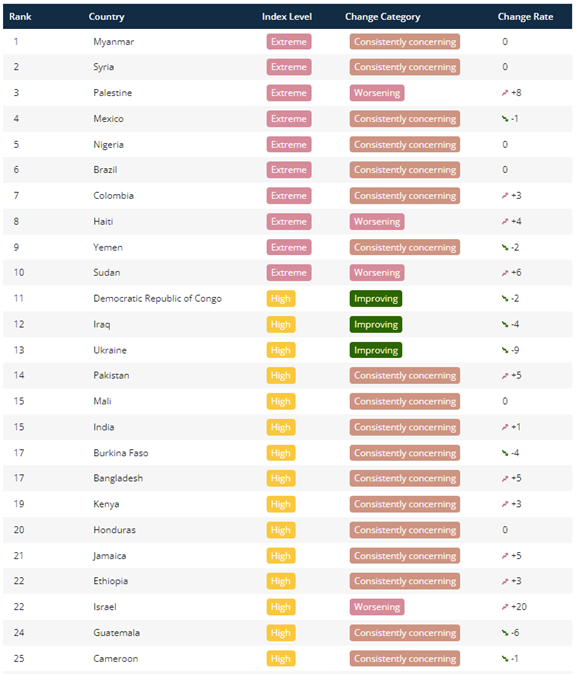
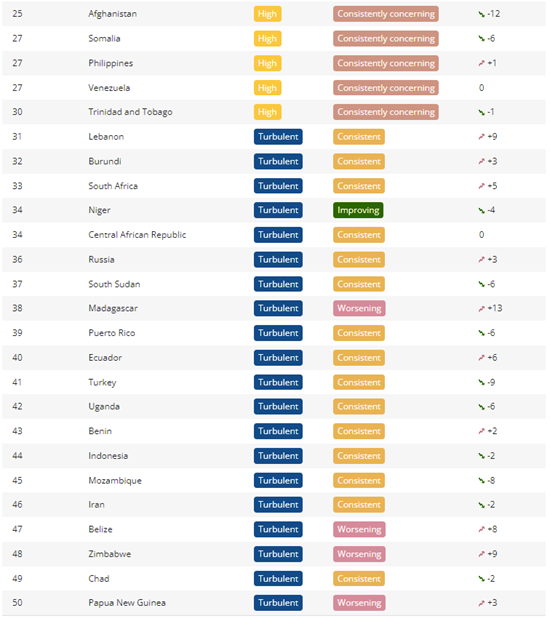
To gain a broader understanding of global conflicts and violence, refer to the Armed Conflict Location & Event Data Project. "The ACLED Conflict Index assesses every country and territory in the world according to four indicators – deadliness, danger to civilians, geographic diffusion, and armed group fragmentation – based on analysis of political violence event data collected for the past year. The top 50 ranked countries and territories are experiencing extreme, high, or turbulent levels of conflict."                                              – ACLED https://acleddata.com/

Country Violence Ratings

From ACLED - see link below

We never have the complete information when we read what passes for the 'news' of the day, information that data marketers carefully choose to provoke primal reactions in readers. Daily reading of only the online news produces a psychological scotoma, a blind spot that blocks one from seeing or accepting anything that contradicts or challenges what we already know. Consider balancing your negative reading by surfing goodnewsnetwork.org. or checking out the transformational work of Global Goodwill Ambassadors.


7. Emotional States

Emotions can impact how we perceive and interpret information. You may be more prone to misunderstanding others when stressed, upset, or anxious. To better understand another person's words, actions, and intentions, calm yourself and then ask "what-if" questions to gain a broader view of the issue. Do you have daily meditation times to relax and clear your head so that your emotions reach a state of homeostasis, and you feel centered?

Cognitive biases, such as confirmation bias or the fundamental attribution error, can influence how we interpret information, leading to misunderstandings. Also referred to as 'self-serving biases,' cognitive bias is our tendency to believe whatever reinforces our existing beliefs and to reject any information that conflicts with those beliefs.

Types of Cognitive Bias

(from TechTarget)


Over six decades of research on human judgment and decision-making in cognitive psychology, social psychology, and behavioral economics, a continually evolving list of cognitive biases has been identified, including the following:

Actor-observer bias

Individuals credit their situation to external causes while ascribing other people's behaviors to internal causes. "I'm the victim" versus "They knew what they were doing."


Anchoring bias

There is a tendency for the brain to rely too much on the first information it receives when making decisions. This is why gossip can be so insidious. Whoever speaks first tends to be taken seriously by others.


Attentional bias

The tendency for an individual to pay attention to a single object or idea while deviating from others.


Availability bias

The tendency for the brain to conclude that a known instance is more representative of the whole than is the case.


Availability heuristic

The tendency to use information that comes to the mind quickly when making decisions based on the future. Heuristics is a mental shorthand for making quick decisions based on previous knowledge. It explains product loyalty.


Bandwagon effect

The tendency for the brain to conclude that something must be desirable because other people desire it. "Everybody's doing it! Come on, jump in!"


Bias is a blind spot

The tendency for the brain to recognize another's bias but not its own. The late Lou Tice of the Pacific Institute referred to this as a mental scotoma. We can't see or repress seeing our faults.


Clustering illusion

The brain wants to see a pattern in a random sequence of numbers or events.


Confirmation bias

The tendency for the brain to value new information that supports existing ideas.


The Dunning-Kruger effect

There is a tendency for an individual with limited knowledge or competence in a given field to overestimate their skills in that field.


False consensus effect

An individual tends to overestimate how much other people agree with them.


Framing effect The tendency for the brain to arrive at different conclusions when reviewing the same information depends on how the information is presented.


Functional fixedness The tendency to see objects as only being used in one specific way.


Groupthink The tendency for the brain to place value on consensus.


Halo effect The tendency for a person's impression in one area to influence an opinion in another area.


Hindsight bias There is a tendency to interpret past events as more predictable than they actually were.


Misinformation effect The tendency for information that appears after an event to interfere with the memory of an original event.


Negativity bias The tendency for the brain to subconsciously place more significance on negative events than positive ones. Our brain has vastly more dopamine receptors for negative memories than positive ones. No wonder it is so easy to remember an insult or offense, but recalling exact words during a tender moment with a loved one is difficult.


Proximity bias

…heightened during the pandemic. People preferred the warmth, fun, and closeness of physically being with someone. They felt less connected to those who were only virtually present. Proximity bias refers to the subconscious tendency to give preferential treatment to individuals who are physically close. A physical worker may be considered for a raise over a remote worker because they are nearer their superior. This is an example of proximity bias.


Recency bias

The brain tends to subconsciously place more value on the last information it receives about a topic. Example: Previously, fans liked a celebrity who epitomized good fatherhood, but after learning of his alleged crimes, they now despise him based on new information.


Self-serving bias

The tendency is for an individual to blame external forces when bad events happen but give themselves credit when good events happen.


Sunk cost effect,

…also called the sunk cost fallacy, is a tendency for the brain to continue investing in something that isn't working in order to avoid failure. We're victims of habits of thought, as Hill suggested.


Survivorship bias

The tendency for the brain to focus on positive outcomes in favor of negative ones. A related phenomenon is the ostrich effect, in which people metaphorically bury their heads in the sand to avoid bad news.


An example of this is the raging Xylazine epidemic, which is barely covered by news media even though it is globally redefining drug dealing, rapidly spreading across the U.S. killing two hundred people per day. Recently, I invited all my State legislators to a Zoom session to develop public awareness about Xylazine. Only one showed. He said legislators "have their heads in the sand" regarding Xylazine. She attended because the horse tranquilizer affected an addicted family member.

Prejudice binds the mind, and blocks new information and influences
Signs and Effects of Bias

from: https://www.techtarget.com

Because cognitive bias is often an unconscious process, it's easier for individuals to recognize a bias in someone other than themselves. Some ways to recognize bias include the following:

  • ·        If an individual attributes success to themselves while attributing other's successes to luck,
  • ·        If an individual assumes they have more knowledge than they actually have on a topic,
  • ·        If an individual insists on blaming outside factors instead of themselves,
  • ·        If an individual is only paying attention to what confirms their opinions and
  • ·        If an individual assumes everyone shares their own opinions.


Poor Listening Skills


Ineffective listening can contribute to misunderstandings. Failing to pay attention, making assumptions, or interrupting can prevent accurate comprehension. Listening is more than silently waiting until you get your turn to speak your well-rehearsed words. Next time someone tells you a story, memorize the details as if there would be a pop quiz afterward. Give them your undistracted, full attention. This will help to pause your tangential self-talk or at least quiet it.


Cultural Differences


Cultural norms and values can affect communication styles. What may be considered appropriate or suitable in one culture might be perceived differently in another.

III. Conflict over Values and Goals

Value conflicts arise when individuals or groups hold different beliefs, principles, or priorities that are in opposition to each other. These conflicts can occur at various levels, including personal, interpersonal, societal, and global. Several reasons contribute to the emergence of value conflicts:

Cultural Differences

Cultural diversity often leads to varying values and beliefs. When individuals from different cultural backgrounds interact, conflicts may arise due to differences in perspectives, norms, and moral frameworks.


Religious Beliefs

Religious values play a significant role in shaping individuals' ethical principles. Conflicts may arise when people from different religious backgrounds have contrasting beliefs or interpretations of moral issues. Abortion is a hotly contested issue because of religious beliefs about terminating an unborn person's life, and more so because it is no longer a personal and private moral decision but a politicized issue.


Ethical Dilemmas

Ethical considerations can be subjective, and individuals may face conflicting moral principles when making decisions. What one person views as morally right, another may see as morally wrong, leading to value conflicts. Capital punishment is an ethical issue. Is it right to kill someone who is a threat to the species? Is capital punishment a deterrent?


Political Ideologies

Differences in political ideologies often reflect conflicting values. People may have opposing views on governance, social justice, and individual rights, leading to political and value-based conflicts.


Generational Gaps

Different generations may hold distinct values shaped by their time's socio-political climate and cultural changes. These generational gaps can lead to conflicts as older and younger individuals may have conflicting perspectives on various issues.


Personal Experiences

Individuals' life experiences shape their values. Two people with vastly different life experiences may hold conflicting values based on their unique perspectives, leading to interpersonal conflicts.


Economic Disparities

Economic differences can contribute to value conflicts, especially when individuals or groups have opposing views on wealth distribution, social justice, and economic policies. AI technology may positively impact the problem of wealth inequity.


Educational Backgrounds

Varied educational experiences can lead individuals to develop different worldviews and values. Conflicts may arise when people with diverse educational backgrounds engage in discussions or decision-making processes.


Media Influence

Media shapes public opinion and values. Conflicts may arise when individuals consume different types of media that reinforce contrasting narratives and perspectives. With so much online misinformation, such as AI deep fakes, people can be and are easily confused and tricked.


Personal Priorities

Individuals may prioritize specific values over others based on personal goals, aspirations, or needs. Conflicts can arise when these priorities clash with those of others.


Lack of Understanding Misunderstandings and lack of awareness about each other's values can contribute to conflicts. Communication gaps and assumptions about others' values may lead to unnecessary disagreements.


Addressing value conflicts requires open communication, empathy, and a willingness to understand different perspectives. Finding common ground, focusing on shared values, and seeking compromise are essential to resolving conflicts arising from differing values. This is essential for productive conflict resolution.

Cultural Differences

Cultural diversity often leads to varying values and beliefs. When individuals from different cultural backgrounds interact, conflicts may arise due to differences in perspectives, norms, and moral frameworks.


Religious Beliefs

Religious values play a significant role in shaping individuals' ethical principles. Conflicts may arise when people from different religious backgrounds have contrasting beliefs or interpretations of moral issues. Abortion is a hotly contested issue because of religious beliefs about terminating an unborn person's life, and more so because it is no longer a personal and private moral decision but a politicized issue.


Ethical Dilemmas

Ethical considerations can be subjective, and individuals may face conflicting moral principles when making decisions. What one person views as morally right, another may see as morally wrong, leading to value conflicts. Capital punishment is an ethical issue. Is it right to kill someone who is a threat to the species? Is capital punishment a deterrent?


Political Ideologies

Differences in political ideologies often reflect conflicting values. People may have opposing views on governance, social justice, and individual rights, leading to political and value-based conflicts.


Generational Gaps

Different generations may hold distinct values shaped by their time's socio-political climate and cultural changes. These generational gaps can lead to conflicts as older and younger individuals may have conflicting perspectives on various issues.


Personal Experiences

Individuals' life experiences shape their values. Two people with vastly different life experiences may hold conflicting values based on their unique perspectives, leading to interpersonal conflicts.


Economic Disparities

Economic differences can contribute to value conflicts, especially when individuals or groups have opposing views on wealth distribution, social justice, and economic policies. AI technology may positively impact the problem of wealth inequity.


Educational Backgrounds

Varied educational experiences can lead individuals to develop different worldviews and values. Conflicts may arise when people with diverse educational backgrounds engage in discussions or decision-making processes.


Media Influence

Media shapes public opinion and values. Conflicts may arise when individuals consume different types of media that reinforce contrasting narratives and perspectives. With so much online misinformation, such as AI deep fakes, people can be and are easily confused and tricked.


Personal Priorities

Individuals may prioritize specific values over others based on personal goals, aspirations, or needs. Conflicts can arise when these priorities clash with those of others.


Lack of Understanding

Misunderstandings and lack of awareness about each other's values can contribute to conflicts. Communication gaps and assumptions about others' values may lead to unnecessary disagreements.


Addressing value conflicts requires open communication on shared values, and seeking compromise are essential to resolving conflicts arising from differing values. This is essential for productive conflict resolution.

IV. Failure to Accept or Act upon Pre-existing Agreements

People break promises and fail to honor agreements for various reasons that can be a complex interplay of individual, situational, and interpersonal factors. Here are some common reasons:

Lack of Commitment

Sometimes, individuals may not have a genuine commitment to keeping their promises or honoring agreements. They might make commitments without fully understanding the implications or without a sincere intention to follow through. Regarding the great American breakfast invented by Edward Bernays, it is said that the chicken promises, but the pig is committed.


Changing Circumstances

Life is dynamic, and circumstances can change unexpectedly. Unforeseen events, such as personal crises, health issues, or unexpected work demands, can disrupt one's ability to fulfill promises.


Over-commitment

Some people tend to overcommit themselves due to a desire to please others or a fear of saying no. Over-commitment can lead to individuals failing to fulfill all their promises due to time constraints or resource limitations.


Miscommunication

Misunderstandings and miscommunication can contribute to broken promises. If there are different expectations or interpretations regarding the terms of an agreement, it can lead to disappointment and unmet expectations.


Prioritization Issues

People may face conflicting priorities, and in some cases, they prioritize other commitments over the promises they made. This happens when individuals feel overwhelmed or pressured to address more urgent matters.


Fear of Confrontation

Some individuals may be hesitant to communicate their inability to fulfill a promise due to fear of confrontation or disappointing others. As a result, they may only address the issue once it becomes unavoidable.


Unrealistic Expectations

Sometimes, promises are made with unrealistic expectations about one's capabilities or the feasibility of the task. When individuals realize they cannot meet these expectations, they may fail to fulfill the promise.


Lack of Accountability

Sometimes, individuals may need a sense of accountability or responsibility for their commitments. They may not fully understand the impact of their actions on others or may not feel a strong obligation to honor their agreements.


External Factors

External factors, such as economic changes, legal issues, or unforeseen events, can influence one's ability to fulfill promises. These factors may be beyond an individual's control.


It's important to note that the reasons for breaking promises can vary widely from person to person and from situation to situation. Building trust, effective communication, and setting realistic expectations can contribute to a more reliable and accountable interpersonal environment.

Napoleon Hills' Reasons for Business Failure

Unfavorable Hereditary Background

This was put first on the list because Hill says it's one of the toughest issues for people to overcome. Hill's choosing this reason as his first reason hints at racism. Hill advises participating in a Mastermind Group to increase brain power by surrounding yourself with more intelligent people.


Lack of a Well Defined Purpose in Life

If you don't have a definitive purpose you're setting out to fulfill and related goals you're trying to achieve, you won't succeed. Usually, this is not given consideration until the later stages of life as we approach death and wonder, "What is my purpose, God?" Having a purpose gives life meaning, rather than just existing and consuming.


Lack of Ambition to Aim Above Mediocrity

There is little hope for people who have zero ambition to improve. Any individual who wants to be successful must put in the effort to rise above mediocrity. Settling for being average seems easy, but the cost is higher in the long run. The easy way becomes hard, and the hard way becomes easy with self-discipline.


Insufficient Education                                                                                                     

Hill suggests that the most successful among us are those who self-educate. A lack of education can be overcome with ambition and passion. Hill said, "Men are paid, not merely for what they know, but more particularly for what they do with that which they know." Never before has education been so broadly available via libraries and online courses and instructors.


Given many high school and college graduates abandon reading books after graduation, if you study your subject for at least thirty minutes to an hour, even a day for six months, you will soon be at the top of your industry in terms of being up to date on current knowledge and innovations in your field.

How many people stop reading after college? Here are two statistics: 33% of high school graduates never read another book for the rest of their lives. 42% of college graduates never read another book after college.


Lack of Self-Discipline

Napoleon Hill, “Self-discipline starts with the mastery of your thoughts. If you don’t control what you think, you can’t control what you do.” Self-discipline pertains to delayed gratification. Putting off the instant reward may seem harder in our culture conditioned by the availability of fast downloads and uber-fast product deliveries.

Ill Health

This is self-explanatory. I'd draw some parallels here with self-discipline. Eat right and exercise daily. Practice a smart sleep regime.

Unfavorable Environmental Influences During Childhood


"As the twig is bent, so shall the tree grow." Most people who have criminal tendencies acquire them as the result of a bad environment and improper associates during childhood.


Procrastination is the most common cause of failure. Timing will never be right, so start where you stand.


Lack of Persistence

The history of business people and entrepreneurs is littered with stories of how persistence was the cause of success, about their getting up and going again after every upset or obstacle.

Negative Personality describes not so much an unlikeable person but more so someone who thinks negatively. Their behavior repels others. Without a positive mindset change, there is little hope of their success.


Lack of Controlled Sexual Urge

Hill goes into great detail on how sex energy is the most potent stimulus of all for moving people into action. He says, “Lack of sexual impulse control can be self-destructive.” He stops short of making direct recommendations regarding sexual impulses. During his time, sex was a repressed, taboo subject. Freud contributed to the theory that sex is a prime motivator.


Uncontrolled Desire for "Something for Nothing"

Hill said, "Business is an exchange of values. I believe you become successful when you are able to help other people or other businesses. There's no such thing as a free lunch." This is the consciousness of scammers' victims who will temporarily suspend judgment to invest belief in someone highly persuasive or something that their friends would probably tell them is 'too good to be true,' the trademark description of bad deals.


Lack of a Well Defined Power of Decision

Hill said that Henry Ford could make decisions quickly and change them very slowly. Tony Robbins says decisiveness is the product of deep inner confidence in oneself and one's abilities, especially in change management. Are you decisive, especially when necessary?


One or More of The Six Basic Fears:

1.   Fear of poverty

2.   Fear of criticism

3.   Fear of ill-health

4.   Fear of loss of love

5.   Fear of getting old

6.   Fear of death


Wrong Selection of Mate in Marriage

Have you ever met someone who was so devastated by divorce that the entire trajectory of their life was altered, their depression projecting them onto a course of self-destruction under a permanent black cloud of despair? Once I knew a man who was so emotionally destroyed by a traumatic divorce that he wallowed in the depths of chronic depression, all the way down to suicidal ideation until a serendipitous miracle of hope turned his life around.

Over Caution is probably as dangerous as under caution. But, with over caution, you will never take risks. No risk, no reward.


Wrong Selection of Associates in Business Often, business problems involve a breach of trust. Intelligent trusting is a skill that can be learned.

"All problems are people's problems. And most people problems are people refusing to act like people."
- Solomon

Superstition and Prejudice

This comes back to fear. “Successful people fear nothing,” said Hill.


Wrong Selection of a Vocation

You'll never succeed in a role you hate. Even if you reached the top of your totem pole, can you deem yourself successful while being miserable in your job? 85% of people hate their jobs. "A global poll conducted by Gallup has uncovered that out of the world's one billion full-time workers, only 15% of people are engaged at work. That means that an astronomical 85% of people are unhappy in their jobs." – Gallup 'Broken Workplace'

Lack of Concentration of Effort

This is a shout-out to whoever has the attention span of a mayfly. But no matter the age, concentrating on something for an extended period of time is hard; it just is. We're back to discipline again. Concentration is a carry-over habit. If you concentrate and focus intensely on the details of your hobby, that ability to concentrate will carry over to other situations. Meditation helps improve one’s ability to focus.

The Habit of Indiscriminate Spending

Do you clarify what your actual needs and wants are? Some get a shoppers' high by spending money. A solution to indiscriminate, impulsive spending may be to commit 1% of your monthly income to yourself. Reinvest some of your money in yourself. Regarding spending time, it is said that poor people spend their time on entertainment. The middle class manages their estates. The wealthy invest time in building networks.


Lack of Enthusiasm

This is where those chasing money will start to fall off unless they are passionate and enthusiastic about how they earn money. Enthusiasm is contagious; people naturally want to work with and for you if you are upbeat. The word enthusiasm is derived from the Greek root "entheos" which translates to "God within." You'll discover your deepest connection to God by doing more of whatever generates the most enthusiasm for you.


Intolerance

The person with a closed mind on any subject seldom gets ahead. The mind is like a parachute. It works best when open. Intolerance means that one has stopped acquiring knowledge.


Intemperance

Says Hill, "Excess of anything usually is bad. The three worst kinds of intemperance that one should remember are connecting with overeating, drinking (alcoholism), and sexual activities." Interesting. I would add ingesting too much news media fluff. If this is you, try a news fast for a week or longer.


Inability to Cooperate with Others

The only way to get what you want is to help other people get what they want, and that won't happen for anybody who refuses to cooperate with others. Cooperation is a game that is well-taught in Robert Axelrod’s book The Evolution of Cooperation. If you've had problems with trusting, read his book.


Possession of Power Not Acquired Through Self-effort

Power seems to be a very delicate thing to master, a difficult thing to attain, and something that takes a great deal to keep. If you've acquired power without having worked for it, you most likely need to gain the skills, habits, experience, and knowledge to know what to do with it.


Intentional Dishonesty – You’ve read in the Decalogue, “Thou shall not bear false witness.” Hammurabi’s Code (1754 BCE) starts with, “If anyone accuses another of murder but cannot prove it, then the accuser shall be put to death.”

Egotism & Vanity

People can spot these two traits in others quite fast, which will warn them to keep away. What have we learned so far? We need people to be successful.

Guessing Instead of Thinking

There will be times when gut feeling wins out, but here Hill speaks about those who are too indifferent or lazy to go and find the facts and information needed to make a well-informed decision.


Lack of Capital

You must spend money to make money, but spend wisely, not impulsively! Usually, this is a significant cause of failure for new businesses. You'll inevitably make mistakes, and mistakes cost money. Also, you need some capital to carry you through the reputation-building stages.


Poor Management

Ineffective leadership, lack of strategic vision, and poor decision-making can lead to a business's downfall. Management plays a crucial role in steering a company in the right direction.


Insufficient Capital


Many businesses need more funding to succeed. Inadequate capital can hinder operations, limit growth opportunities, and make it challenging to weather economic downturns.


Market Conditions

External factors, such as economic changes, consumer behavior shifts, or increased competition, impact a business's performance. Failing to adapt to market conditions and disruptions can lead to decline. Study trends.


Ineffective Marketing

A business must effectively reach its target audience and differentiate itself from competitors to attract customers and generate revenue. This is especially true for look-alike practitioners.


Poor Financial Management

Inaccurate financial planning, mismanagement of cash flow, and failure to control expenses can lead to economic instability and, ultimately, business failure. If you must, hire a professional for guidance.


Lack of Innovation

Businesses that fail to innovate and adapt to technological advancements or changing customer preferences may become obsolete. This has been the death knell for big businesses such as Sears, Nokia, and Best Buy. Systemic innovation, a Peter Drucker concept, helped many businesses that were forced to suddenly adapt to the 2020 – 2022 pandemic crisis. The book Remoteability – 12 Tactics to Manage the Culture of Your Suddenly Remote Team is helpful.


Inadequate Planning

Lack of a solid business plan, including a clear vision, goals, and strategies, can leave a business without a roadmap for success. Usually, a startup has the luxury of time in the early stages of business development that will not be available later when the business has grown. Yet, entrepreneurs spend less than 5% of their time on strategic planning and refining plans.


"The average entrepreneur spends 68.1% of the time working 'in' their business—tackling day-to-day tasks, putting out fires, etc. — and only 31.9% of the time working 'on' their business — i.e., long-term goals, strategic planning."— The Alternative Board - Feb 26, 2016


Failure to Manage Risks

Businesses face various risks, including operational, financial, and market risks. Failure to identify, assess, and manage these risks can lead to significant problems. When was the last time you did a SWOT analysis?


Poor Customer Relations

Ignoring customer feedback, providing poor customer service, or failing to meet customer expectations can result in loss of customers and damage to a business's reputation.


Legal and Regulatory Issues

Businesses must comply with various laws and regulations. Failure to do so can lead to legal troubles, fines, and damage to a company's reputation.


Supply Chain Disruptions

Dependence on a single supplier or a poorly managed supply chain can expose a business to disruptions, affecting the production and delivery of goods or services.


Overexpansion or Rapid Growth

Growing too quickly without proper infrastructure, resources, or market demand can strain a business and lead to financial instability.


In summary, relationships in business and the personal realm can face challenges for various reasons. Issues like miscommunication, conflicting interests, and external pressures can strain connections. But by openly addressing problems, communicating well, and understanding each other, businesses and individuals can fix broken bonds. Just try. Learning from these challenges can help build stronger and longer-lasting partnerships in the ever-changing world of business.


-Frank DeDominicis

REFERENCES:

Recent Posts

July 7, 2026
This article in this series will be concise for two reasons: 1) It's a nasty subject that is already amply covered by many other researchers and writers; 2) My preference is to move beyond statistical reports and societal trends to defining root causes of violence, and to suggest some proactive strategies for mitigating workplace violence. As case studies abound, instead, I will share observations about the core reasons for workplace violence and some ideas for how to prepare for and prevent violence. AI suggested providing statistics and case studies, which will be listed below in the reference area. I do not want to flood your mind here with evidence of man's inhumanity to man. You already know that mass shootings have transitioned decades ago from a rare occurrence to hundreds every year, so I won't bore you with bloody references. Overall, during the past few years, there has been a downward trend in violence in our cities' streets. To me, the real tragedy is that we have been conditioned to accept violence as commonplace and usual, when we should be outraged at the continual loss of lives and sanity. Alas, many seem too mesmerized by the latest bad news event to stop and focus on preventive measures. Enlightened leaders install workplace violence policies and protocols.
July 6, 2026
December 25th commemorates the birth of the most influential, controversial life, that of Jesus Christ, whose teachings centered on the phrase "Love one another." This universal ideal is a vision of a utopian society resonating with peace and harmony. However, despite this lovely aspiration, we confront a sobering reality of a world of persistent "wars and rumors of wars," casting doubts for many about the possibility of society ever attaining an enduring peace and power equilibrium worldwide. Often, particularly from young people, I hear discouragement and negative expectations about the future. The contemporary state of our global affairs is a disheartening landscape. Societal discord, aggravated by wealth inequality, ethnocentric prejudices, mismanagement of natural resources, and ingrained biases, paints a bleak picture of our collective future. Today's youth grow up in a world where negativity, although not representative of the larger reality, dominates daily news noise, including distressing reports of an average of two mass shootings per day. The mass migration from personal tete-a-tete conversations in actual rooms to virtual communications has accelerated narcissism. Our self-interest drives us to draw the attention of Facebook contacts by posting pictures from our personal lives, environs, and even our meals. Instead of dwelling solely on negative trends, let’s probe deeper into the underlying societal shifts and their root causes. Toward the end of this article, we'll explore the multifaceted nature of love as defined by the ancient Greeks. Even in conflict, such as war, an underlying motivation emerges, love for one's country, a form of self-love. Numerous surveys conducted in the United States indicate a decline in empathy over the past four decades, with the recent acceleration attributed to factors like the prolonged lockdown, increased social media dependence, and online addiction.
July 6, 2026
The January 2026 Minneapolis tragedies—especially the ICE murders of Renée Nicole Good and ICU nurse Alex Jeffrey Pretti—have evolved from ‘breaking news’ to what psychologists term a ‘cascade of collective traumas.’ The relentless flow of disturbing reports significantly impacts people, both positively and negatively, creating fertile ground for those who profit from chaos and confusion. The Minnesota failures of our safety system are ‘critical error’ messages in our social contract. ICE criminal abuse events, captured on high-resolution video and distributed via 24/7 news cycles, are a profound psychological ‘distraction engine’ that directly impacts the modern workforce, everybody from the custodial engineer down to the lowly and humble CEO.
July 6, 2026
Like you, I am always trying to make sense of things, especially the deepest, most perplexing, confusing, or foreign things. As a much younger man, one of the most foreign things I’ve never really completely understood was how global trade magically and smoothly emeshes the distribution of natural resources and manufactured components for goods for the 166 World Trade Organization members. Recently, I’ve re-learned that global trade is anything but smooth and simple. In fact, the experts taught me how to properly perceive the reality of the current world trade situation and its inevitable trajectory towards increasing chaos and uncertainty. So, here’s a curious outsider’s insights into a complex and politicized arena: international trade.
By Frank DeDominicis May 26, 2026
Employee Healthcare can cost half as much. Just imagine a world without co-pays and high deductibles. “In the world of employee benefits, a seismic shift is underway, and it's causing tremors of concern for some of America's biggest companies,” says Jed Cohen, cofounder of Fiduciary In A Box . He reports“ Attorneys filed a first-of-its-kind against Johnson & Johnson for its employee health benefits plan.” Recently I learned from Bob Hilke, an expert in Wellness and Healthcare, about a positive and hopefully healing tsunami of change rolling over our broken health care system. Given the perennial corporate problem of employee retention, finite dollars available for costly employee health insurance benefits programs, and inertia inherent within the current purchasing practices, I am impressed by the efficiency and effectiveness of the Nuka health system. Unlocking the Benefits of the Nuka Healthcare System The Nuka System , pioneered by the Alaska Native Medical Center, revolutionizes healthcare with its patient-centric approach. Emphasizing preventive care, continuity of care, and cultural competence improves health outcomes while respecting community traditions. Medical experts from around the world come to Alaska to study the system. While Nuka is the only healthcare system to receive the Malcolm Baldrige award TWICE and many countries from all over the world come to Alaska to see the Nuka Healthcare System, Alaska rarely receives visits from any of the other USA forty-nine states to see the Nuka system. Preventive care is prioritized, reducing the need for costly interventions. Integrated care teams provide personalized treatment plans, enhancing patient satisfaction and outcomes. Cultural sensitivity fosters trust and effectiveness in healthcare delivery. Recent news highlights ERISA violations by significant corporations, underscoring the need for ethical healthcare practices. As advocates for patient welfare, we must prioritize systems like Nuka that prioritize patients over profits.
By Frank DeDominicis November 19, 2025
The American business landscape is silently bleeding. For decades, a hidden, metastasizing cost has consumed profits, eroded competitive advantage, and driven employee anxiety: the national healthcare crisis. Often cited as the second-highest expense on a company’s balance sheet, healthcare spending today represents a systemic failure, offering diminishing returns for escalating premiums. It is a cost that CEOs have learned to dread, manage, but never truly solve.