
Marston's DiSC Theory Revisited: Exposing the Hidden Assumptions

August 7, 2026

Share this article

The notion that women are more subject to persuasion when dependent on others is a generalization that does not apply universally to all individuals. A complex interplay of individual characteristics, situational factors, and Context influences people's susceptibility to persuasion. Gender, while it may play a role in shaping socialization and experiences, is just one of many factors that can affect a person's vulnerability to persuasion.


Key Considerations


Individual Differences

There is substantial variability among individuals, regardless of gender, regarding their susceptibility to persuasion. Personal traits, such as self-confidence, critical thinking skills, and assertiveness, can significantly affect one's resistance to persuasion.

Situational Factors

The context in which persuasion occurs is important. Vulnerability to persuasion may depend on the specific situation, the nature of the persuasive message, and the individual's emotional state at the time.


Psychological Factors

Psychological factors, such as cognitive biases, prior beliefs, and social influence, can all play a role in susceptibility to persuasion. These factors can affect people of any gender.

Cultural and Societal Influences

Cultural and societal norms and expectations can influence how individuals respond to persuasion. Norms vary widely across different cultures and communities.


Dependence and Interdependence

The extent to which an individual is dependent on others is just one factor to consider. People may be dependent in various ways, such as financially, emotionally, or socially, and these dependencies may influence their responses to persuasion differently.

Various factors influence people's responses to persuasion, and individuals can vary significantly in their susceptibility. It is helpful to approach these topics with nuance and avoid making gender-based generalizations.

"Male style is analytical and manipulative."

Another study of U.S. governors found that states with female leaders had lower fatality rates.

"There may be common learning experiences based on anatomical facts that help create some of the psychological reactions observed more often among women, i.e., their interest in interdependence, their idea that they must give up on something to get another, etc."

While it is true that there are some biological and hormonal differences between men and women, such as differences in their brain structure and function, it is not appropriate to directly link these differences to complex psychological reactions or behaviors.


The development of psychological traits and behaviors is influenced by biology, genetics, upbringing, cultural and societal norms, and individual experiences. Attributing specific psychological reactions solely to anatomical differences overlooks the complexity of human behavior and the interplay of multiple factors. Psychological traits cannot be simplistically attributed to gender or anatomical differences.


Scientific research generally recognizes that behavior and psychology are influenced by a combination of biological, genetic, environmental, and social factors. Researchers in psychology and neuroscience conduct extensive studies to understand these complex interactions better.

To further comprehend, one should refer to peer-reviewed scientific studies and research in psychology, neuroscience, and gender studies. It is important to approach these topics with nuance and respect for the diversity of human experiences and perspectives.

The tendency for women to belong to more organizations and circles than men can vary based on numerous factors, including individual preferences, cultural expectations, and life circumstances. There is no one-size-fits-all answer to this question, as women's and men's levels of involvement in organizations and social circles can vary widely.


Factors to Consider


Cultural and Societal Norms

Women may be encouraged or expected to participate in various community, family, or social organizations in some cultures and societies. These cultural norms can influence women's involvement in such groups.


Lifestyle and Life Stage                                                                                                                         

Life circumstances and lifestyle choices can impact participation in organizations and circles. Women may become more active in community organizations due to their roles as caregivers, including involvement in parent-teacher associations, neighborhood groups, or social clubs.


Work and Career

Career demands and work-related commitments can influence organizational participation. Some men and women may choose to be more or less involved in extracurricular activities based on their career demands and time constraints.

Individual Personality and Interests


Personal preferences and interests play a significant role. Some individuals, regardless of gender, are naturally inclined to be involved in multiple organizations and social circles, while others may prefer more limited involvement.


Availability and Access

The availability of organizations and circles in a particular community can also influence participation. In some areas, more opportunities for involvement in various groups may exist. Personal preferences and a complex interplay of societal, cultural, and individual factors influence the level of involvement in organizations and social circles.


"Women will give their will in submission in exchange for feeling secure and loved."

Selected Resources
Let’s identify biases and flaws in Dr. William Moulton Marston's conclusions about human behavior. First, let's learn a bit about Marston and some little-known salacious details about him, the origins of the DiSC theory, and the EverythingDiSC™ profile.

Marston's accomplishments

Education: PhD in Psychology from Harvard University in 1929


Director: Public Service: Universal Studios, 1929

Personal Adviser to Carl Laemmle, founder of Universal Studios

Lecturer: University of Southern California (circa 1929-1930)

Professor: Psychology, Long Island University, 1931-1933

Vice-President of Hampton, Weeks, and Marston advertising agency, 1932.

Lecturer: New School of Social Science (New York, 1933-1934) and Rand School of Social Science (New York, 1933-1934)

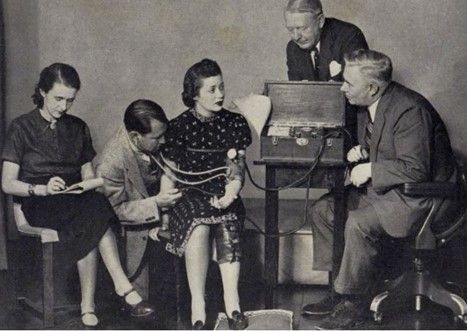
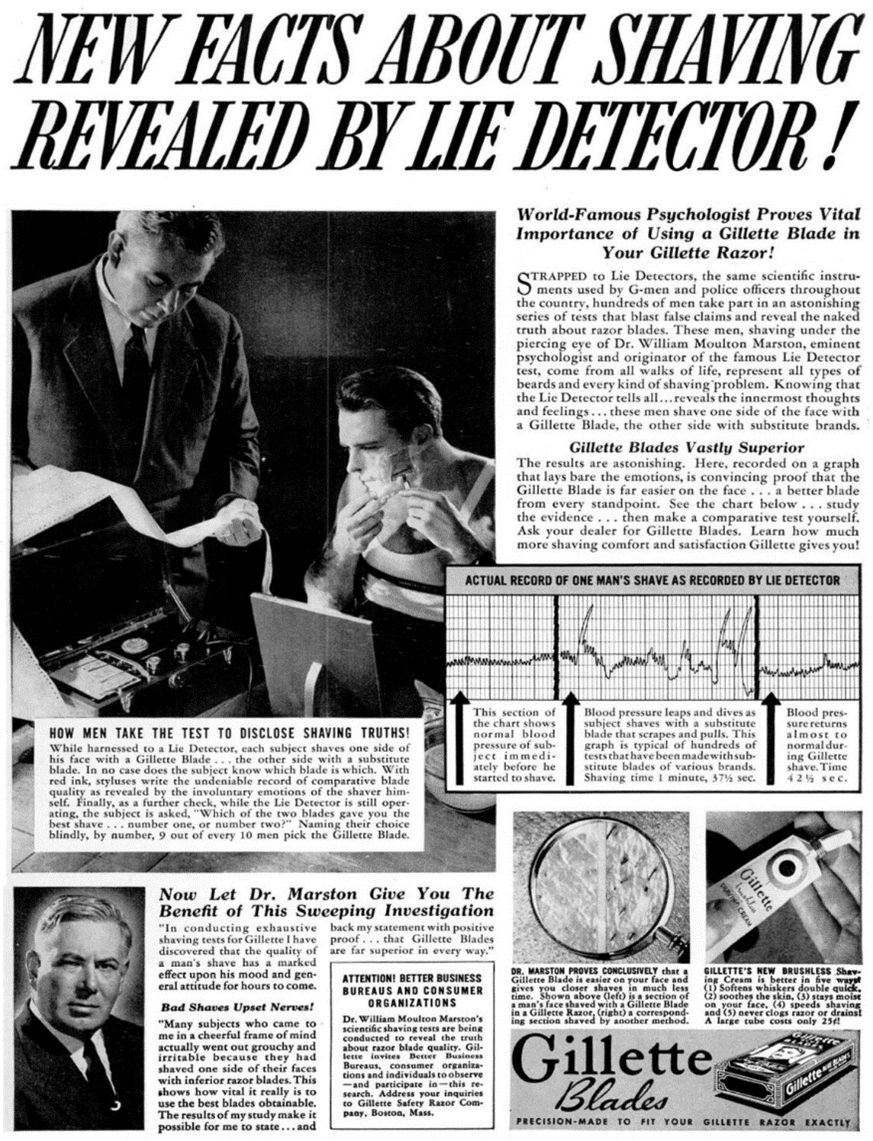
Gillette Ads: He appeared in a 1938 Gillette Blade advertisement in nationwide magazines promoting his "lie detector" and Gillette razor blades.

OSS: He claimed he "shrunk heads" for the Office of Strategic Services, the precursor intelligence agency to the CIA during World War II.

Polygraph invention

His wife, Elizabeth Holloway, who famously said, "Harvard will not grant me a PH.D. because I have a vagina," noticed that whenever she became agitated or angry, her heart beat faster and her blood pressure rose. This observation led to Marston's invention of the systolic blood pressure test, which became a vital component of the modern polygraph (lie detector) machine. One of his tests 'proved' that brunettes are more easily titillated than blondes.


To promote his invention, Marston suggested that the results of his machine testing be included in the famous Frye vs. United States case, the first time an expert witness tried to testify in a court case. In 1923, in Frye v. United States, the District of Columbia Court rejected the scientific validity of the lie detector (polygraph) because the technology did not have significant general acceptance at that time.

Publications

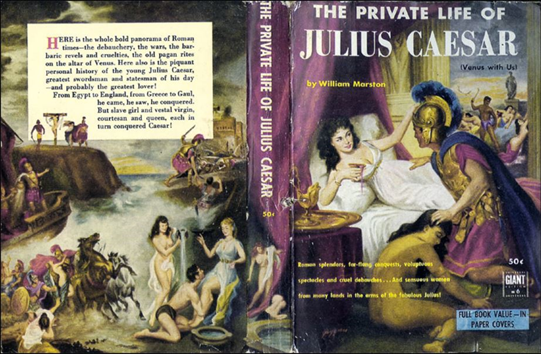
Appealing to the prurient interests of the times, Dr. William Moulton Marston wrote paperback books, including The Hidden Life of Julius Caesar, which is thusly described: "Here is the whole bold panorama of Roman times—the debauchery, the wars, the barbaric revels and cruelties, the old pagan rites on the altar of Venus. Here also is the piquant personal history of the young Julius Caesar, the greatest swordsman and statesman of his day and probably the greatest lover! He came, saw, and conquered from Egypt to England, Greece to Gaul. But slave girl and vestal virgin, courtesan, and queen, each, in turn, conquered Caesar!"


Comic Books and Film

In the early 1940s, after publishing an article highlighting comics' educational potential, he consulted for DC Comics (then All-American Publications). Marston believed comic books could have positive educational and psychological value, especially for young people. 

Marston’s Views on the Value of Comics

Comics could teach moral lessons and positive ideals through the heroic feats and behavior of characters like Wonder Woman, whom he envisioned as a strong feminist icon.


Comics' combination of words and pictures made the medium effective for conveying ideas and stories in an engaging, easily understandable way for children and adults.


Comics could provide a safe outlet for readers to explore themes of power, submission, and bondage through the adventures of heroes like Wonder Woman using her lasso of truth.


He felt comics had been underestimated and scorned when they could be uplifting entertainment that instilled good values and portrayed strong role models.


In his 1944 book The Wonder Woman, Marston argued that comic books "should be issued by an agency aiming to inculcate the right ideas," promoting love over violence as the driving force. He saw Wonder Woman comics specifically as a way to shape youth culture in a positive direction. His Wonder Woman comics were intended as constructive brainwashing about women and their inducement power versus the dominant power style of Superman and Batman.


Classic DiSC Theory

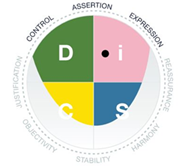
Marston created the EverythingDISC™ theory of personality assessment, which categorizes behavior along two axes - favorable/unfavorable perception and active/passive tendencies. These axes are also referred to as the power and affection axes.


While innovative, DiSC theory originally received little mainstream acceptance. Today, it is recognized as the education and training industry's most trusted behavioral assessment instrument globally. Over 70 million individuals have used it, and another million every year. Rating highly on validity and reliability scores, it is utilized in various settings and applications, including emotional intelligence and productive conflict.


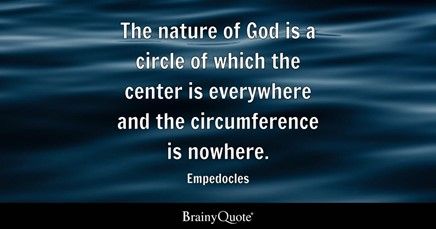
DiSC is actually a 2400-year-old theory of personality based on the observations of the Greek philosopher Empedocles (c. 450 BC), who was the first to propose the four classical elements as a set: fire, earth, air, and water. He called them the four "roots" (ῥιζώματα, rhizōmata).

DiSC Style Definitions

Dominance - control, authority, rule, supreme influence, the condition of being dominant, or having the authority to influence or control.


Influence - the capacity or power of persons or things to be a compelling force on or produce effects on the actions, behavior, opinions, etc., of others: the action or process of producing effects on the actions, behavior, opinions, etc., of another or others,.


Submission - an act or instance of submitting or yielding control to a more powerful or authoritative entity: unable to escape a grappling hold; the act or condition of submitting something for consideration, approval, treatment, or action.


Compliance - the act of conforming, acquiescing, or yielding; a tendency to yield readily to others, especially in a weak and subservient way; conformity; accordance: in compliance with orders; cooperation or obedience.


Major DiSC™ Points

High Validity

The original (EverythingDiSC™) instrument measures precisely what it purports to measure: specific behaviors relative to the pure D, i, S, and C styles.


High Reliability

The instrument is rated as highly reliable. Participants agree with 80%+ of the interpretations.


Global Reputation

EverythingDiSC™ is recognized as the most trusted behavioral instrument in modern education and training. It has been and is utilized by a significant number of major organizations.


Predictability

Most importantly, the DiSC profile is not predictive, although some think so.


Variability

Although the personalities of emotionally mature people tend to be consistent in most settings, with some others, their personalities may shift dramatically based on environmental factors such as the setting, others' presence, and the time of day, as well as the effects of, trauma, alcohol or medications.


SEEs

Significant emotional events shift values, affecting personality expression.


DiSC is not a personality test, and it does not reveal typology, despite the tendency of people, especially those new to DiSC, to label themselves and others, which initially creates separation. It's about interpersonal tendencies, not 'types,' a popular misnomer.


Relative Expression

The D, i, S, and C plotting plots are relative to each other in terms of their magnitude of expression.


Limitation     

DiSC describes styles based only on current input data.


Three aberrant profiles, the undershift, tight, and overshift ('unhealthy' profiles'), were eliminated in the 1980s.


Based on the over 70 million profiles in the Wiley database, you are just as likely to encounter any of the four styles in society. Some copycat 'DISC' companies report the spread differently based on their database. One organization with only 24,000 profiles claims the majority are high "S's," a prejudicial error.


Despite claims by some DiSC novices, we do not have two personalities. Our primary personality style is observable when we are at emotional equilibrium. However, the "Productive Conflict" DiSC profile may reveal a completely different personality style.


Premarital Counseling                                                                                                                 

Clerics have extensively used DiSC for premarital counseling. Hence, the participants benefit from getting a glimpse past the rose-colored glasses of romantic love and being forewarned about possible stress behaviors and how we instinctively behave when triggered. 

A comprehensive study of one's profile includes three stages:

Basic interpretation of your style's primary emotions, inhibitions, fears, and value to the team.


Understanding social and work compatibility factors, interpersonal tension points, and conflict behaviors.


Personalized depth research is available via podcasts, real and blind comparison reports, intensity measurements, and other resources, including classic and missing patterns and advice on 'stretch' behaviors on the Catalyst platform.


Free Love

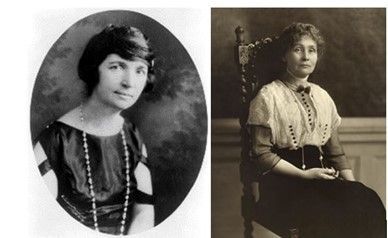
Marston lived in a polyamorous relationship with his wife, Elizabeth Holloway, and their partner, his graduate student Olive Byrne. Both women inspired the creation of Wonder Woman. Olive Byrne was Margaret Sanger's niece and a compatriot of and influenced by Emmeline Pankhurst.


A third woman, Marjorie Hutchings, with whom Marston is said to have had an affair when he was a lieutenant in the Army, is rumored to have lived in the attic of their communal house in Rye, New York, where she hung beads and burnt incense. In Rye, New York, their triad sexual exploits were revealed publicly, causing him and his wife to fall out of respect in academia and to descend into the lowly world of comic books.


The concept of free love originated in the mid-19th century and was originally about the absence of legal ties in romantic and sexual matters, such as marriage, birth control, and adultery. It was a sign of bohemianism until the 1960’s when it became associated with the ‘sexual revolution’ and the hippie movement. However, the idea of free love has roots that go back even further, with influences from the English poet Percy Bysshe Shelley, the suffragettes, and the American Jazz Age.

“Not even girls want to be girls so long as our feminine archetype lacks force, strength, and power. Not wanting to be girls, they don't want to be tender, submissive, peace-loving as good women are. Women's strong qualities have become despised because of their weaknesses. The obvious remedy is to create a feminine character with all the strength of Superman plus all the allure of a good and beautiful woman." – William Marston

DC Comics & Film

After the launch of Superman in 1938 and Batman in 1939, Detective Comics published in 1941, 'Wonder Woman,' a superheroine created by the American psychologist and writer William Moulton Marston (pen name: Charles Moulton) and artist Harry G. Peter. Marston's wife, Elizabeth, and their life partner, Olive Byrne, are credited with his inspiration for the character's appearance.


Wonder Woman, originally named Suprema, appears in American Comic Books which was published by DC Comics. She is a founding member of the Justice League, and first appeared in All-Star Comics #8, published October 21, 1941, with her first feature in Sensation Comics #1 in January 1942. The superheroine title has been published by DC Comics almost continuously ever since. In her homeland, the island nation of Themmyscira, her official title is Princess Diana of Themyscira.


When blending into the society outside of her homeland, she sometimes adopts her civilian identity, Diana Prince, originally named Suprema, reflecting Marston's bias that women are exceptional in ways that would make them better politicians. I now see how male and female politicians' behaviors vary greatly and often to extremes. Male politicians tend not to be catty or to make insults about others’ appearances, except for morally immature ones. 

Wonder Woman

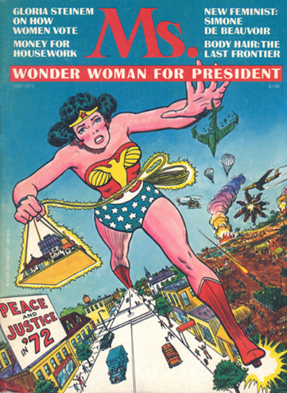
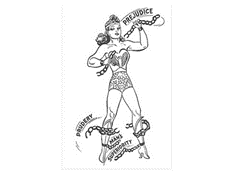
Marston created the comic book character Wonder Woman in 1941 as an empowered female superhero and feminist icon, as public propaganda about feminine inducement power. He gave her the ‘Lasso of Truth,’ inspired by his work on lie detection.


In the 1940s, second-wave feminism was not about equality, but rather superiority. Marston's personal and obvious obsessions colored his interpretation of dominance/submission tests, which were limited to only a few hundred participants and which he and Miss Olive Byrne conducted with young men and women. One of his generalizations is that young men tended to submit to female teachers but complied with male teachers, submission being pleasurable and compliance being unpleasant. He faced criticism for the bondage undertones and alleged sexual subtext in his depictions of Wonder Woman, as bondage is included in every sixth cartoon panel.


His psychological works promoting female superiority and unconventional views on sexuality were seen as controversial at the time. He believed true love manifested when one totally submitted to a loving authority. In his sexual encounters, roles were reversed between players.

Marston said, “She’s as lovely as Aphrodite, as wise as Athena, with the speed of Mercury and the strength of Hercules, but she is known only as Wonder Woman. From a psychological angle, it seemed to me that comics' first offense was their blood-curdling masculinity.” 

Marston's Biases

He believed that young boys naturally tend to be submissive towards young girls but then become rebellious towards their fathers, suggesting an inherent gender difference in submission tendencies. Often, he described men as dominating brutes lacking the natural sensitivity of the female gender, clearly a sexist prejudice.


In his seminal 1928 book, Emotions of Normal People, he cites the contrasted examples of college-aged men and women during hazing events, suggesting women enjoyed submission to bondage and public spankings with a paddle vigorously applied to their buttocks. In contrast, boys tended to resist forced compliance. Marston observed that troubled teenage boys at a school would act submissive when caught misbehaving by the male principal, "Mr. H.” would try to dominate the female principal instead. They attributed this to societal gender norms rather than any inherent differences.


He claimed that the emotion of submission is "really evident in young boys in relationship to other young girls," implying boys are naturally submissive to girls. However, he also said submission is not based on gender; instead, society forces people to react in specific ways based on gender. He claimed happiness resulted from active submission to a loving authority.


Marston believed that women are more naturally altruistic and benevolent than men. his idea that women are inherently more nurturing contributed to the creation of his Wonder Woman character. While Marston acknowledged societal influences on gender roles, he also expressed some essentialist beliefs about innate gender differences, especially in his ideas that submission and altruism are more natural tendencies for women and girls.


His fascination with pornography and bondage reflects his gynocentric focus. The bias was essentially that men are inherent brutes and women are heavenly, 'active lovers.' I challenged some of the conclusions because his behavioral experiments in schools and facilities were limited to small numbers of participants, some only a few hundred individuals. In his book Emotions of Normal People, he admits that several of his conclusions are based on his subjective 'emotional education.' His biases are obvious.


These views reflected common gender biases of his era. What educated, modern woman today would agree that women are naturally other-centered and submissive and that men are not?


-Frank DeDominicis

REFERENCES

Leadership behaviors with Frank DeDominicis and DiSC™                                                   

Leadership and DiSC


Polygraph invention                                                               

https://liedetectortest.com/polygraph-examiner/william-moulton-marston-progressing-polygraph-technology


Three Dysfunctional DiSC Styles                                         

https://www.linkedin.com/pulse/three-dysfunctional-disc-styles-frank-dedominicis/?trackingId=SrKrLkqjQEKS%2FMUJEjoKfw%3D%3D


How to Deceive a Polygraph Machine

https://www.youtube.com/watch?v=N3fHkCFxgQQ


Margaret Sanger and Contraceptives as a Constitutional Right

https://www.linkedin.com/pulse/three-dysfunctional-disc-styles-frank-dedominicis/?trackingId=SrKrLkqjQEKS%2FMUJEjoKfw%3D%3D


Emmeline Pankhurst - Suffragettes and the Cat and Mouse Syndrome

https://www.youtube.com/watch?v=NL5s9dk9U4w&t=1s


What Emmeline Pankhurst Really Said About Eugenics, Race, Free Love

https://www.thoughtco.com/free-love-and-womens-history-3530392


Professor Marston and the Wonder Woman (Full Movie 2017) Get your popcorn!

https://www.tokyvideo.com/video/professor-marston-and-the-wonder-women-2017

Recent Posts

August 10, 2026
Generally speaking, most adults consider play as something extra after the to-do list is completed, a reward for accomplishing a task, or a diversion from something serious and heavy. In actuality, it should be considered vital for mental health because, without it, we ignore the child in us who wants to explore, test, and play. Play is inherent in human and animal natures.  Being in the early days of Act III of life and preparing for a good death, I am more serious about things and consciously scheduling play times. I assign play equal weight, if not greater, to other life priorities such as work, worship, friendship, and love. I've enjoyed many hobbies that provide great satisfaction, but with aging, I've pared them down to only a few. If I were to live as long as my centenarian mother, I have time to read only 1000 new books, so I'd better carefully choose what I put into my head. Likewise, protecting play time is essential to my mental health.
August 10, 2026
Lest you mistake this article for a Timothy Learyesque' drop-out' message, I'd like to be clear. While retreat is a common tactic in war, it is intended to help regain posture and consolidate power resources, rather than abandoning the battlefield. Thanks to the internet, many of us are bombarded daily with cognitive overload from useless information, if we allow such abuse. Unfortunately, constantly staring at screens has become the norm for many humans. It is estimated that approximately 70% of the world's population, or nearly 5.775 billion people as of July 2025, is online. Is this a good thing or a bad thing?  The answer is that it is both. The internet has dramatically shrunk and flattened our world of communication, which is excellent for collaborative ventures, but which also benefits malicious actions by begrudged individuals.
August 10, 2026
Given the current state of social devolution (a term used to describe the decline in social interactions and relationships,) I'm fortunate to have been rated on a managerial whole-brain profile as an ambivert. Like most people, I naturally feel a strong and continuing need for social connection; however, I can also be perfectly content with solitude and meditation for extended periods. Socializing is natural for me. I quickly and easily build rapport and trust. Thus, my social world acts as a reservoir of good energy to recharge and remind me of who I am whenever I need a confidence boost, as I likewise edify my friends and allies. Being cocooned and busy helping e-commerce businesses, I hardly noticed the lockdown. However, as a friend said, "the pandemic revealed the rocks in the bottom of the creek." One study claimed that 64% of the people surveyed said they find it difficult to talk with people of widely different religious or political views. Why is this so? Perhaps we are so invested in our point of view that we cannot, or do not suspend self-interest for a few minutes to assume a sincerely curious, journalistic attitude like Monica Guzman, author of I Never Thought of It That Way.' She claims, "The friction and heat in a conversation is good. The question is whether it's cooking something or burning something. Standing for what you believe in does not mean attacking people on the other side." Indeed, the lockdown exacerbated the tone of relationships. Those who were close sought to become even closer. Those who were distant increased their transactional tone of communications, a term used to describe interactions primarily focused on exchanging information or completing tasks rather than building relationships. The report reveals a steady downward trend in social connection and civility over the past four decades. This slippery slope trend is borne out in a pithy white paper by the U.S. Surgeon General entitled Given the extensive nature of the paper, I will comment on only a few striking excerpts, which I hope encourages you to read the entire report.
August 7, 2026
The EverythingDiSC™ model reveals that it is natural for individuals to have different levels of various needs. When there is a great disparity in individual needs for dominance and control, interpersonal patterns of pressure and automatic compliance can evolve. This can work wonderfully if the more dominant personality always makes the best decisions, but that is unrealistic.  What if both parties are aggressive drivers who like to win? This can be a serious problem whenever a situation demands that push comes to shove. What do I recommend? Involve a disinterested third party to moderate discussions and to ensure that both parties practice active listening. Agree to effort toward workable compromises, as in peace negotiations.
August 6, 2026
Understanding where you stand within the context of public mood cycles may help you consider the background of others' behaviors. Yes, we're worried, and the biggest worry is uncertainty, so here are facts to help ease your fears. We will touch on only some problematic matters. Drop me a line for any issues I've missed and for which you'd like more information.
August 6, 2026
Chapter I: Understanding Elder Abuse
August 5, 2026
How to Reduce Defensiveness
August 4, 2026
When I began my research for this article, I reached out to thought-leaders in the ageism field for their input on how ageism is not only a globally rampant prejudice but it is also negatively affecting commerce, particularly in human resource hiring and retention practices. Ageism affects job applicants who are over forty years of age. Some companies have even developed prejudicial job applicant screening and hiring practices as showcased in their controversial ‘rebranding programs.’ To begin, let’s expand our thinking about what ‘age’ is for the majority of us who usually refer to it as a number, our chronological age. In fact, there are four other types of age to consider as author Helen Hirsh Spencer explains in her March 5th, 2026 LinkedIn newsletter article, How Do You Define Old Age? She says, “When you’re asked about your age, where is the first place you go? I bet it’s to the number of years since your birth. In other words, you consider your Chronological age. But there are so many other types of age to consider, such as: Biological age refers to your physical well-being and how your body compares to the average person of the same chronological age as you. Functional age is based on your ability to perform a task, job, or activity determined by an assessment. Examples include hearing, seeing, and memory. Psychological age involves learning and memory. Social age refers to your emotional maturity, ability to self-regulate and depends significantly on societal expectations. The US hit an age cliff in 2025 with the number of 18-year-old youths now in decline Fertility rates, and immigration are also on the decline which means there is a need to retain, retrain or engage older workers. Unfortunately, ageism clouds reason.”  Something else to consider about intersecting socio-dynamic trends and their combined impact is that although the future is not predictable, the current hiring trends' trajectory path of hiring youth and firing elders, will become a catalyst for change in a shrinking labor market.
Show More