


Tariffs, My R/V Refrigerator, and Urban Myths about Stress

September 25, 2026

Share this article

Animal Nepotism

The practice of favoring relatives or friends for jobs or promotions involves several systemic and organizational disadvantages:

Managers may find it hard to be fair when supervising family members. This complicates reviews, discipline, and pay talks because personal feelings get involved.

Close personal relationships often involve a ‘shorthand’ communication style. This can lead to faster decision-making and a more unified vision at the executive level, as goals and perspectives often align.

What is Nepotism in the Workplace?

Favoritism, Nepotism, and Legacy Employees https://www.youtube.com/watch?v=O-6r_v-tVr0

during shifts. The manager also posted a sexually explicit ‘scoreboard’ tracking staff members' private sex lives in the main office. When the employee complained, coworkers retaliated against him, and he was ultimately forced to resign. Chipotle settled with the EEOC for $95,000 paid directly to him. This is just one example of male sexual harassment cases that seldom make sensational news.

My Refrigerator as Metaphor for Tariff Stressors 

1975, when I was in my early 20s, a guitar-picking country boy infected by wanderlust and the In romance of the endless road ahead, I custom-designed and built a crazy, Rube Goldberg-inspired recreational vehicle. Trained in the building trades, I utilized the best tools, quality materials, and equipment.


After rebuilding the engine, I suspended it from a big tree branch to start it up (I'm good at self-entertainment). Also, I installed a DC/AC power inverter dual-charging system, which fed a power strip so I could enjoy all the amenities of home, including fresh water from a galvanized, pressurized water tank, a solar cooker, and a shower.


Envious of Michelangelo's multiplicative talents, I cut the roof off a Ford Econoline and, atop it, welded the top half of a Volkswagen Transporter so I could stand up and make a bunk over the cab. I installed a recycled Chevrolet Corvair auxiliary heating system, a propane stove with an exhaust fan, and a four cubic-foot Norcold refrigerator that then cost about $400 USD. The same appliance now costs $1000 USD and will likely increase in price given Trump's import tax rampage.


Manufactured initially only in the USA, in 2022, Norcold Inc. closed domestic U.S. manufacturing facilities and switched to four other global manufacturing locations. The final assembly plant resides in the USA, and the parts received have sub-components from various countries. Tracing every raw material and component back to its origin would be a complex and massive undertaking.


Consider all the parts of a fridge: compressors, electronics and control boards, plastic components, metal components, glass shelves, insulation materials, and all the cooling system components such as condensers, evaporators, and tubing.


Based on general knowledge of global manufacturing, AI search results, and in terms of manufacturing and the required labor for the assembly of parts and sub-components, major players are China, Italy, Mexico, Germany, South Korea, Japan, Thailand, Indonesia, Philippines, Vietnam, Brazil, India, Czechia, Slovakia, France, Spain, and the somewhat politically United Kingdom, which are all hugely involved in the trade of refrigerator parts.


Norcold utilizes intricate global supply chains to source various parts based on cost, specialization, and availability. However, supply chains are thrown into a lurch by Trump's intentional crashing of global stock markets, which he calls "medicine."

Mad Math 

Trump attempts to sell to the public, especially the under-educated, his provocative nominalization: "trade deficit," a blatant misnomer. Natural trade volume differences exist because of population size differences. With Canada's population being about 11% of the United States of America's population, naturally, there are fewer Canadian consumers of American products than there are Americans purchasing products from Canada. Eleven Nobel-prize-winning economists say it is ridiculous to expect the same exchange rates between countries, as population sizes always differ. They warn that tariffs are self-defeating and a bad idea. Doh!

S.T.R.E.S.S. acronym

Commonly-accepted false belief affirmations:


S—"Some stuff upsets me." No! You upset me most of the time. Except for major traumas, we can usually learn to calm down and control our reactions to everyday stressors like insults, slander, or hurt feelings. Psychological inurnments, like fur balls, nose-picking, and flatulence, are part of life. We all live with them but do not discuss them.


We who consider ourselves resilient do not sacrifice our mental thinking time to what psychiatrists refer to as 'blocking and distracting thoughts.' Instead, we take a simple tip from cognitive behavioral therapy and consciously learn how to change our attitude and mind about things, to try on different 'what if' points of view. This type of exercise can help to build empathy for enemies, opponents, and critics.


If a disturbance is slight, purely on the emotional level, you can rationalize a new, ethical attitude that is positive, beneficial, and productive to feel relieved of negative attitudes that hurt to experience. Our ability to consciously choose our attitudes is key to managing stress.


Why hold onto stuff like hate and resentment? Forgiveness is powerful for all parties involved. The problem is that sometimes, we do not set boundaries or ignore the yellow

pressures, or money issues. Of the complaints listed, only 4% were in the present, and half of those things involved the need for the influence or power of others, leaving only 2% as problems that could be dealt with right now. flags of intuition and healthy T – "They" are to blame. – Here we go again with the victim mentality! Yes, 'they' did terrible things, but that was then, and this is now. You can end persistent thoughts that keep you emotionally stuck in the past and instead focus on a goal that makes you look forward to a better future, perhaps as a solution to a relationship problem. We can join the positive-thinkers and positive-doers, such as Global Goodwill Ambassadors, and get busy instead of falling into sheeple lockstep, reactive to prevailing trends.


Blame is a natural visceral reaction to being offended or hurt, but, like an untrained dog, it is a passion that must be curbed if you are ever to have real inner peace. For the next thirty days, consciously make an effort to become more self-aware of and pause negative  self-talk, whining, and complaining, and then observe what happens in all areas of your life, including physical health. If apropos to you, become aware of your mind's impulsive self-pity parties and stop thinking. Movement helps: Stretch. Dance. Go for a walk.


R – Reality check complaints - How 'real' are my complaints? One Midwestern university study showed that most things that worried people were in the past. Some worrisome things were in the future, like relationship concerns, deadline


Does the source of my complaint exist in the real world, or do I live in my head with a tortured mind that expands the pain of a situation by consciously thinking and obsessing about the past for extended periods? Perhaps the serenity prayer would fit in well here.


In deference to those to suffer acute trauma, I want to be sensitive and gentle and not advise, "Just stop being depressed," as well-intentioned but uninformed persons advise.

The 'just snap of it' advice advocated by self-acclaimed personal growth gurus is not that easy to accomplish if you're the victim of a horrible crime. Intense emotional shock changes us, and the transition from shock to normalcy and inner calm is a gradual instinct. Then we say that we're upset because of "them," externalizing the root of the problem. If we're upset, we own the problem, not others.


healing process that takes as much time as needed, a different length of time for everyone, sometimes fast, sometimes years, or never.


So, yes, we can qualify some of our problems as real, but let's first acknowledge the dual nature of all human problems: the external problem description and our emotional reaction to the problem. Consider both to determine if you're dealing with an external experience or a subjective reality complaint. Define the problem clearly in simple words.


E – "Everybody has stress." – Okay, I'll agree with this…sort of. First, let’s return to the origin of the scientific study of stress by Canadian father of stress research Dr. Hans Selye, whose Hungarian word 'erőfeszítés' was misinterpreted as 'stress,' when it more closely meant the word 'effort.'


Given that homeostasis of human physiology is based on biochemical ‘efforts,’ we can safely say that everybody has stress. On the other hand, when we say 'stress,' are we usually referring only to adverse or emotionally expensive events like losses or broken bonds? If we can agree with the pre-assumption that all people experience physical stress, can we also say that all mental stress is bad or debilitating? Consider the stressful environment embraced by high-altitude climbers, but considered fun. Achievers choose to embrace the challenge despite fear, feelings of unpreparedness, or confidence issues. Do the thing you fear, and fear will vanish.


Success stressors can be the worst, as we have seen with young, nouveau riche Hollywood success to downfall stories created because of pleasure temptations such as shopping therapy, drug and alcohol self-abuse, debauchery, and legal issues. Often, sudden wealth becomes a return to poverty because of a common stressor: indiscretion with money. Some examples of people who couldn’t handle success stresses are below.


S – "Some people are thorns in my side." – Blaming others for our stress is common. We should be looking at how well we respond to stressors. If the correct value filters are in place, the impact of stress may feel weaker.


Blaming others for interpersonal stress is an indication of other things:


1. Inability to reconcile interpersonal problems with or without others' cooperation.


2. Lack of awareness about style differences.


3. Unwillingness or inability to forgive and let go.


4. A perma-victim mentality. This is especially true if you cannot admit your faults and weaknesses and your part in conflicts with others.


5. Rigid thinking – If we do not allow for the fact that people can change, and often do, we may hold grudges for years. Some individuals have a cruel nature and enjoy torturing others, especially abusive narcissists. (Refer to the book It's Not You below.)


6. Codependency is a common condition that includes an inability to express one's feelings constructively, people-pleasing behaviors, and poor boundary-setting.

I know a dysfunctional family in which one of the adult children, the caretaker by default, buried their dead mother without previously informing siblings about her condition or of the funeral and reception. All the children are ACOA but deny it.


S – "Stress is bad." - Is it? Have you ever heard of good stress: 'eustress' – the natural high experienced by meditators and runners? Negative stress can be debilitating, especially if it is constant like water dripping on a rock every day. Chronic stress can lead to or influence physical and mental health problems. Yes, it can be harmful. We can counter negative stress with positive stressors, the exciting things that make us smile, get excited, and feel inspired and invigorated. For some, it's base-jumping. That's stressful, but in a good way.


I hesitate to advise because every mind and body is different; however, to maintain a semblance of sanity, I schedule ample guilt-free stressors, including pre-scheduling ample breaks for rest, rejuvenation, creativity, and play. Plan and protect your time.


Success over stress is true self-mastery. Do you have control over your thoughts? Do you know about automatic or hidden thoughts? Automatic thoughts are spontaneous, impulsive first thoughts that come to mind when we experience stress. For example, someone forgets to return your call. Your automatic thought is, "I'm being disrespected. I won't stand for that!"…and then comes resentment and seething anger.


The next time this same event happens to you again, stop for a moment and, on second thought, ask 'what if' questions. What if they forgot to call because they were in a car crash? How would I feel? What if they couldn't call because they were unexpectedly driving in a cellular service blackout area? What if? You can always talk yourself out of a bad attitude if you take the time to use the usual resources available to do that

People Who Couldn't Handle Success Stressors

If you suddenly won the lottery, would you fall prey to money mismanagement, too? Folks below won the lottery and then amazingly returned to poverty:


· Willie Hurt (Michigan Lottery, $3.1 million in 1989): Just two years after winning, Hurt was broke, addicted to crack cocaine, and facing murder charges. He spent his winnings on drugs and a divorce.


· Suzanne Mullins (Virginia Lottery, $4.2 million in 1993): Despite splitting her winnings with family, Mullins became bankrupt after helping her uninsured son-in-law with medical bills and taking out a loan against her future winnings.


· Lara and Roger Griffiths (UK National Lottery, £1.8 million in 2005): This couple spent their winnings on a luxurious lifestyle and bad investments. Their marriage collapsed; by 2013, Roger reportedly had only £7 left.


· Callie Rogers (UK National Lottery, £1.9 million in 2003): At 16, Rogers was Britain's youngest lottery winner. She quickly spent her winnings on cosmetic surgery, partying, and gifts. By 2013, she reportedly had only £2,000 left.


· Ronnie Music Jr. (Georgia Lottery, $3 million in 2015): Instead of investing his winnings, Music Jr. used the money to fund a crystal meth ring and was later sentenced to 21 years in prison. 


· Michael Carroll (UK National Lottery, £9.7 million in 2002): Carroll, a sanitation worker at the time of his win, quickly squandered his fortune on parties, drugs, cars, and more. By 2008, he admitted that only £500,000 had remained, and he eventually returned to his former job. 


· Evelyn Adams (New Jersey Lottery, won twice in the 1980s, over $5 million total): Adams reportedly gambled away all of her winnings in Atlantic City. 


· Janite Lee (Missouri Lottery, $18 million in 1993): Despite giving generously to various causes, Lee filed for bankruptcy just eight years after her win, reportedly with $2.5 million in debt and only $700 left. 


· Billy Bob Harrell Jr. (Texas Lottery, $31 million in 1997): Harrell quit his job, bought multiple properties, and donated generously. However, the constant requests for money and poor financial decisions led to his financial ruin and eventual suicide.


· David Lee Edwards (Powerball, $27 million in 2001): Edwards and his wife squandered their fortune on lavish purchases, including multiple expensive cars, a mansion, and a jet. They were bankrupt and living in a storage shed within just a few years.

What People Currently Fear

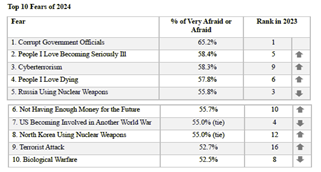
To help shape your new, uplifting, stress-freeing attitudes, here's what Americans fear:

If these fears worry you, commit to learning what decisions would benefit you regarding tending to your mental garden and lifestyle. Self-education is a great way to alleviate fears, but not primarily via the internet. Think of how we pursued self-development before the web. Those methods still work. We can directly address our fears and learn about their root causes.


In the pre-internet early 90s, I feared my drinking water in Tempe, Arizona, would be poisoned by a massive volatile organic chemicals spill by Motorola Corporation. Wanting information on drinking water quality in the Phoenix Valley area, I knocked on the door of the Arizona State EPA head honcho, who greeted me. He was happy to have an interruption in the middle of his bureaucratic day. I interviewed him about the prediction that a certain number of people living in the affected area would develop cancer. In some cases, such as lobbying, seeking out sources and initiating direct contact action can be more effective than only a web search. Hence, massive 50501 ‘Hands Off' protests at U.S. State Capitols are in full momentum.


I encourage you to control of your thoughts, to challenge negative automatic responses, and proactively cultivate eustress to achieve self-mastery over stress.  Understanding and managing our internal responses is key to navigating personal anxieties and broader economic uncertainties that will likely continue for an extended time.


Don’t worry. Be realistic.


-Frank DeDominicis


REFERENCES:

Norcold Story:                                                                                                  https://www.whio.com/news/local/norcold-plant-closures-impact-more-than-300-employees/MN3TMXR67RE6HJSAYCOAUIKWWI/#:~:text=The%20WARN%20notice%20filed%20last,31.

Worry About US Economy and Social Insecurity                                       https://news.gallup.com/poll/658910/worry-economy-healthcare-social-security-surges.aspx

It’s Not You – Ramani Durvasula                            https://audiobookstore.com/audiobooks/its-not-you.aspx?campaign=dynamic_ads&source=google&medium=ppc&gad_source=1&gclid=CjwKCAjwktO_BhBrEiwAV70jXl3G2w-IRzmAz1kHzzE4HPQ5wSnDpIo59V0RpdbZXl8A24ah94IqqRoC24AQAvD_BwE

Phoenix, Arizona Motorola VOC accident and groundwater contamination: https://www.epa.gov/newsreleases/epa-releases-proposed-plan-motorola-52nd-street-superfund-cleanup-phoenix#:~:text=The%20contaminants%20in%20groundwater%20at,4%2Dtrichlorobenzene%2C%20and%20naphthalene

Fear Survey 2024                                                                                     https://www.chapman.edu/wilkinson/research-centers/babbie-center/survey-american-fears.aspx

How to Calm Down https://drive.google.com/file/d/1mDWFY8Q2m0ekSsTSgGNhY33HtLJ0VKt9/view?usp=drive_link

Recent Posts

September 25, 2026
I will start with only one word. Not a headline, not a statistic, only a single word that followed me around a conference room in downtown Denver in May of 2026 as I mingled with Colorado’s largest manufacturing executives. I was participating in the 52nd World Trade Day Conference, the largest international gathering of international trade professionals, policymakers, and business leaders. This year’s theme was blunt: “A New Era in Trade: Globalization in Question.” The keynote wasn’t about growth strategy or market expansion. It was titled “Safeguarding Trade in a Weaponized World Economy.” Every speaker I listened to and every hallway conversation I eavesdropped on kept circling back to that same word. Not tariffs, not GDP, not affordability, but ‘uncertainty.’ The word ‘uncertainty’ isn’t just a trade-conference buzzword. It’s showing up everywhere. Meanwhile, economists who track something called the World Uncertainty Index — a measure built from language in global news coverage — clocked its highest reading in more than three decades of data earlier this year. The index’s newest national poll found that nearly half of adults say they’re more anxious than they were a year ago — and when researchers asked people what’s driving that anxiety, the economy topped the list, with roughly seven in ten adults reporting they feel anxious about it. And uncertainty is not confined to our minds and our markets. It’s in the terra firma beneath us. Geophysicists studying the San Andreas and San Jacinto faults in Southern California recently reported that the two faults are carrying more accumulated stress than at any point in the last thousand years. If they were to rupture together through the Cajon Pass, researchers estimate the resulting earthquake could reach magnitude 7.4 to 7.8 — enough to simultaneously disrupt highways, rail lines, and energy corridors across multiple cities.

September 25, 2026
The necessity of integrating the EverythingDiSC™ profile into vocational training for people with disabilities is rooted in its ability to facilitate deeply personalized and meaningful career planning, a crucial element for ensuring successful employment outcomes. It acknowledges that job success relies far more on behavioral competencies than on technical ones.

September 25, 2026
Arthur Schlesinger Schlesinger was born in Columbus, Ohio, the son of Elizabeth Harriet (nee Bancroft) and Arthur M. Schlesinger (!888-1965), an influential historian at Ohio State University. His paternal grandfather was a Prussian Jew who converted to Protestantism and married an Austrian Catholic. According to family tradition, his mother, a Mayflower descendant, was of German and New England ancestry and a relative of historian George Bancroft. Schlesinger practiced Unitarianism. As a writer, I am confronted with three problems: 1. Everyone reading this has unexamined biases. 2. Embedded biases can color how one perceives stories of religious intolerance. 3. Gross ignorance. I am figuring out how to please everybody who reads this; however, I welcome intelligent argument if you think I'm off. I do not proselytize for any religion but hope every individual will map their path of faith, even if it is a path of no faith. Just identify your spiritual horizon and head for it. Simple. What I know is all that I know, a finite library of cerebral knowledge. Outside that subjective reality lies a vast universe of ignorance, my reason for open-mindedness and humility. At my core, I'm a perma-skeptic who continually questions everything, especially long-embedded personal 'truths' and hidden biases. Notwithstanding actual apparitions, I tend not to believe abstract concepts unless they are carefully and logically derived through reason and are perceived by my senses. If I think I hear divine voices speaking to me, am I crazy? Or am I receiving the voice of God speaking to me through the megaphone of conscience, just like Joan d'Arc? I don't know. That's why I explore this subject with you. I'm blessed or cursed with being born with an extreme curiosity about everything and how everything indescribably connects to everything else. Please receive this report for awareness, not necessarily agreement with every point. I could make mistakes, so please don't crucify the piano player. Aware that this report will be read by everyone, from non-practicing or devout Christians to befuddled agnostics and confirmed atheists, I strive to communicate in a way that reports, educates, and contributes to understanding differences and their core reasons. Knowing how belief systems directly affect one's worldview and behavior is helpful as you may lead, manage, or interact with people. Are Catholics more hopeful because a scapular guarantees salvation? Are Protestants more negative because of a focus on our inherently sinful nature? Remember that I am not a theologian, so feel free to challenge whatever you disagree with or want to provide correction. I'm a teacher, not a preacher. On all matters, I take a Socratic approach, always searching for higher-quality questions, as in AI prompt engineering.

September 25, 2026
Historical Context and Ubiquity
September 24, 2026
Men Being Harassed at Work by Women
September 24, 2026
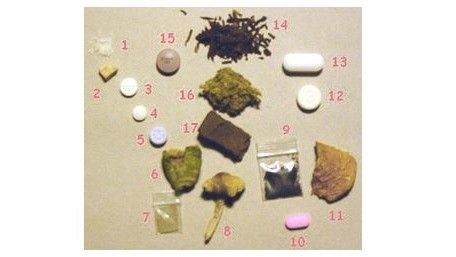
How many psychoactive drugs can you identify?

John F. Kennedy and Robert F. Kennedy at a congressional hearing, illustrating a discussion of nepotism in public office.
By Frank DeDominicis • September 22, 2026
Explore the risks and potential benefits of nepotism through historical, political and workplace examples and what fair leadership requires.

August 10, 2026
Generally speaking, most adults consider play as something extra after the to-do list is completed, a reward for accomplishing a task, or a diversion from something serious and heavy. In actuality, it should be considered vital for mental health because, without it, we ignore the child in us who wants to explore, test, and play. Play is inherent in human and animal natures.  Being in the early days of Act III of life and preparing for a good death, I am more serious about things and consciously scheduling play times. I assign play equal weight, if not greater, to other life priorities such as work, worship, friendship, and love. I've enjoyed many hobbies that provide great satisfaction, but with aging, I've pared them down to only a few. If I were to live as long as my centenarian mother, I have time to read only 1000 new books, so I'd better carefully choose what I put into my head. Likewise, protecting play time is essential to my mental health.

August 10, 2026
Lest you mistake this article for a Timothy Learyesque' drop-out' message, I'd like to be clear. While retreat is a common tactic in war, it is intended to help regain posture and consolidate power resources, rather than abandoning the battlefield. Thanks to the internet, many of us are bombarded daily with cognitive overload from useless information, if we allow such abuse. Unfortunately, constantly staring at screens has become the norm for many humans. It is estimated that approximately 70% of the world's population, or nearly 5.775 billion people as of July 2025, is online. Is this a good thing or a bad thing?  The answer is that it is both. The internet has dramatically shrunk and flattened our world of communication, which is excellent for collaborative ventures, but which also benefits malicious actions by begrudged individuals.

August 10, 2026
Given the current state of social devolution (a term used to describe the decline in social interactions and relationships,) I'm fortunate to have been rated on a managerial whole-brain profile as an ambivert. Like most people, I naturally feel a strong and continuing need for social connection; however, I can also be perfectly content with solitude and meditation for extended periods. Socializing is natural for me. I quickly and easily build rapport and trust. Thus, my social world acts as a reservoir of good energy to recharge and remind me of who I am whenever I need a confidence boost, as I likewise edify my friends and allies. Being cocooned and busy helping e-commerce businesses, I hardly noticed the lockdown. However, as a friend said, "the pandemic revealed the rocks in the bottom of the creek." One study claimed that 64% of the people surveyed said they find it difficult to talk with people of widely different religious or political views. Why is this so? Perhaps we are so invested in our point of view that we cannot, or do not suspend self-interest for a few minutes to assume a sincerely curious, journalistic attitude like Monica Guzman, author of I Never Thought of It That Way.' She claims, "The friction and heat in a conversation is good. The question is whether it's cooking something or burning something. Standing for what you believe in does not mean attacking people on the other side." Indeed, the lockdown exacerbated the tone of relationships. Those who were close sought to become even closer. Those who were distant increased their transactional tone of communications, a term used to describe interactions primarily focused on exchanging information or completing tasks rather than building relationships. The report reveals a steady downward trend in social connection and civility over the past four decades. This slippery slope trend is borne out in a pithy white paper by the U.S. Surgeon General entitled Given the extensive nature of the paper, I will comment on only a few striking excerpts, which I hope encourages you to read the entire report.
Show More